
 Available in US
Content

Why integrity is part of smart betting
Most betting guides treat integrity as a footnote, a paragraph of disclaimers tacked on at the end. I think that’s backwards. Knowing how clean a market is, and which corners of it aren’t, is one of the most practical pieces of knowledge a bettor can carry, because it tells you which prices to trust and which to treat with suspicion. Integrity isn’t the moral appendix to betting. It’s part of reading the market.
And tennis has a story worth understanding here. The sport accounted for a quarter of all suspicious-betting alerts logged across every monitored sport in 2025, with 74 tennis alerts out of a total in the hundreds. That’s a striking share for a single sport, and it isn’t because tennis is uniquely corrupt. It’s because tennis has a structural vulnerability that betting markets and integrity bodies watch like hawks, and once you understand that vulnerability, you understand both where the risk lives and, crucially, where it doesn’t.
This guide is the level-headed version of the integrity conversation. We’ll look at how suspicious-betting monitoring actually works, what the 2025 data really shows once you read it properly, what a betting alert means and emphatically does not mean, how an alert turns into a sanction, and where responsible-gambling support sits for a UK bettor. The goal isn’t to scare you off tennis. It’s the opposite: to show you that the showpiece events you’re most likely to bet are also the most heavily watched and the cleanest, and to point you at the parts of the sport where a little caution is genuinely warranted.
How suspicious-betting monitoring works
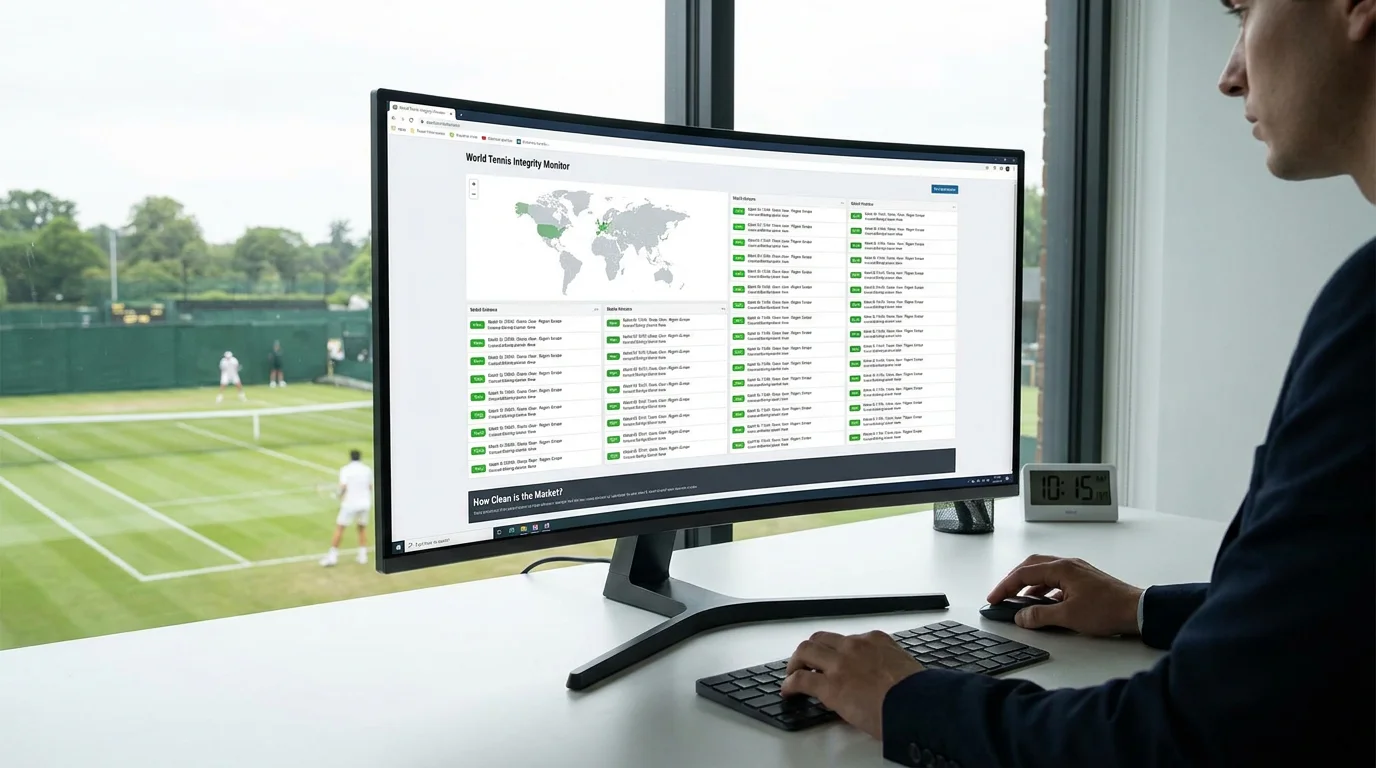
The scale of the surveillance around tennis betting is something most punters never glimpse, and it changes how you should think about the prices on your screen. Behind every match sits an apparatus of monitoring that would not look out of place in financial markets, and it exists because betting itself is the best early-warning system for corruption that sport has ever had.
The principle is straightforward. When the result of a match is rigged in advance, the people who know tend to bet on it, and their betting leaves a fingerprint, a pattern of money that doesn’t match what the public information about the match would justify. Monitoring systems watch betting markets across the world in real time, looking for exactly those anomalies: a flood of money on an unlikely outcome, prices moving against the run of public expectation, volumes that don’t fit the profile of the match. The betting itself betrays the fix.
The scale is genuinely vast. One integrity association alone monitors over 1.5 million matches a year across more than 80 sports, covering betting volumes that exceed £300 billion. A major data and integrity firm tracked more than a million events across 70 sports in 2025 and flagged 1,116 as suspicious, which means more than 99.5% of all the sporting events it monitored showed no sign of anything wrong at all. Hold onto that last figure, because it’s the one the alarming headlines never lead with. The overwhelming majority of sport, and the overwhelming majority of tennis, is clean.
The monitoring matters to you for a concrete reason. The markets that attract the most money and the most scrutiny, the show-court matches at a Grand Slam like Wimbledon, are the hardest in the world to manipulate, because any anomaly stands out instantly against enormous, transparent volumes. A fix needs obscurity to work. It needs a quiet match, light betting, few eyes. The brighter the spotlight, the safer the market, and there is no brighter spotlight in tennis than Centre Court in July.
It’s worth understanding why betting markets, of all things, make such an effective detection net. A rigged result is information, and information leaks. The handful of people who know the outcome in advance face an almost irresistible temptation to profit from it, and the only way to profit is to bet, which means the corruption has to express itself through the very markets being watched. A fixer can keep a secret from the press and the public, but they cannot keep it from the betting record, because the betting record is how they cash in. That’s the elegant trap at the heart of integrity monitoring: the act of profiting from a fix is the act that exposes it.

The cross-border nature of the surveillance closes the loopholes that used to exist. Money placed in one jurisdiction on a match played in another, through accounts that look unconnected, still aggregates into a pattern when monitored centrally. The reach of one global monitoring platform across more than 80 sports and £300 billion in tracked volume means there are fewer and fewer dark corners where a suspicious bet can hide. A fixer trying to spread their money thinly across many books to avoid detection is, increasingly, spreading it across books that all report into the same watching eye.
What the 2025 integrity data shows
Numbers in the integrity world get quoted to frighten, so let me lay out the 2025 figures and then tell you what they actually mean, because the gap between the two is where most people go wrong. The raw data sounds alarming. The interpretation is far more reassuring, and far more useful.
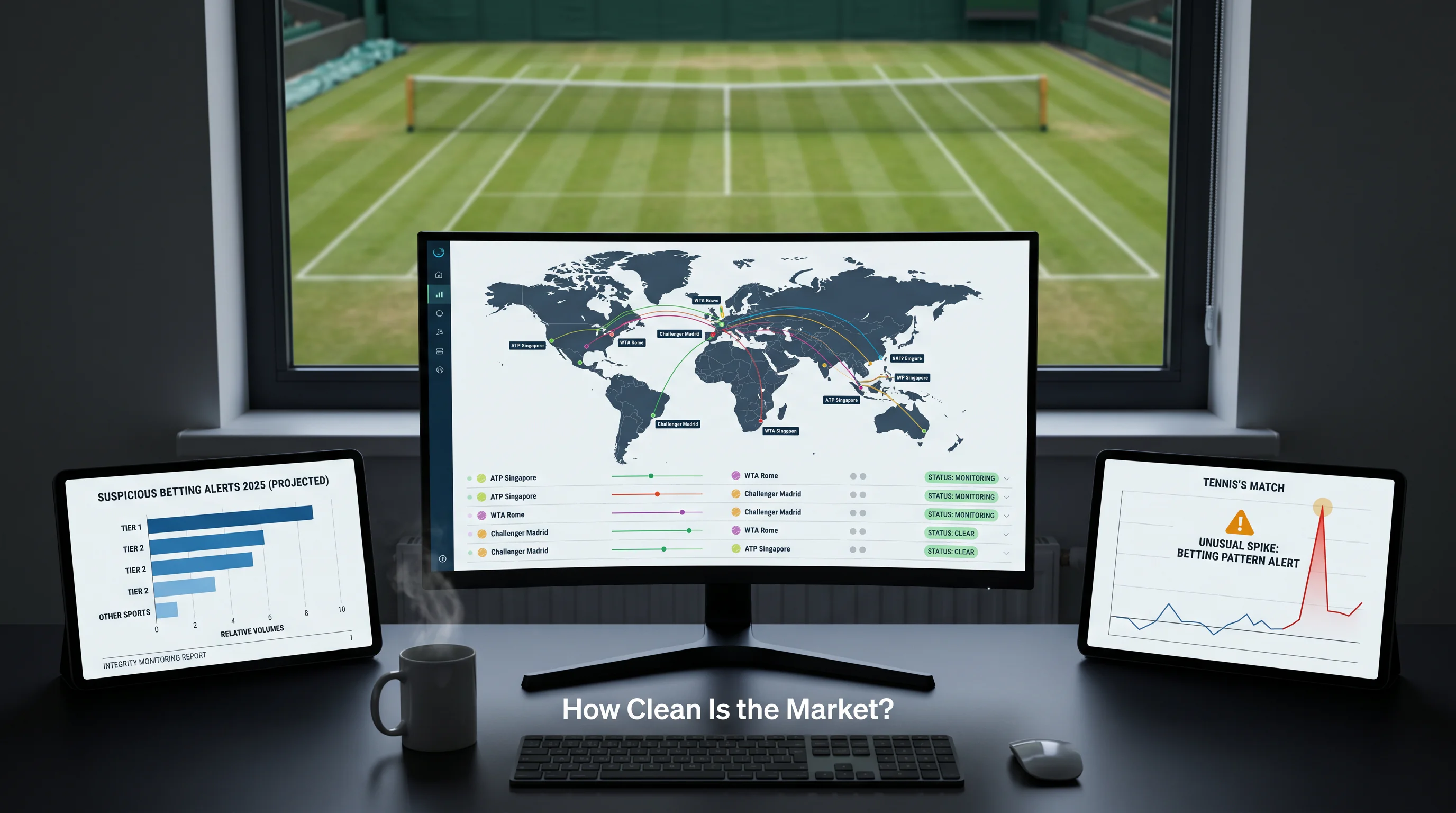
Start with the headline rise. One major integrity association recorded 300 suspicious-betting alerts in 2025, up 29% from 232 the year before. Tennis contributed 74 of those, around a quarter of the total, while football contributed 110, about 37%, and together the two sports made up over 61% of all suspicious cases for the year. A separate integrity firm flagged 78 suspicious tennis matches across its own monitoring in 2025, a rise on the previous year, though football at 618 and basketball at 233 dwarfed tennis in absolute terms. And in the third quarter of 2025, tennis briefly overtook football for the first time in a year, accounting for around 30% of suspicious cases against football’s 25%, out of 121 alerts that quarter.
Now the interpretation, which matters more than any single figure. The head of one integrity body has been blunt that a rising alert count is not the same as a rising problem. As he put it, the growth to 300 alerts in 2025 “should not be read as a direct indicator of increased integrity risk.” More than that, he’s argued that “higher alert volumes in mature markets often indicate stronger detection capability rather than higher inherent risk.” Read those two statements together and the alarming headline inverts: more alerts can mean the watchdog is getting better at watching, not that the sport is getting dirtier. A market that produces more alerts is often a market that’s being monitored more effectively.
The deeper truth about tennis sits in why the sport is uniquely exposed, and the head of the International Tennis Integrity Agency has framed it more sharply than anyone. Corruption in tennis, she’s noted, is “cheating to lose,” in contrast to doping, which is “cheating to win,” and that distinction explains the sport’s vulnerability. A single player can throw a match without a teammate noticing, because there is no team. As she put it, “it only takes influencing one person to fix something.” Tennis is an individual sport, and the individual is the whole point of failure. That’s the structural reason tennis shows up disproportionately in integrity data, and it has nothing to do with the elite matches you’re likely to bet.
So the data, read properly, tells a layered story. Tennis carries a real and well-documented integrity risk, the watchdogs are increasingly good at catching it, and the vast majority of the sport, especially at the top, is clean and clean precisely because it’s watched. The numbers aren’t a reason to avoid tennis. They’re a map of where to be careful.
What a betting alert actually means
The word “alert” does a lot of damage, because it sounds like a verdict, and it absolutely is not. This is the single most misunderstood concept in the whole integrity conversation, and getting it right will stop you jumping to conclusions every time a price does something odd during Wimbledon.
A betting alert is a flag, nothing more. It marks a match where the betting activity looked unusual enough to merit a closer look. It is the beginning of a question, not the answer to one. The integrity bodies are careful to stress this, and the International Tennis Integrity Agency states it plainly: “Any match alert is an indicator that something inappropriate may have happened. It is important to note that an alert is not in itself evidence of match-fixing.” An alert says “look here,” not “guilty.”
The reasons an alert can fire without any wrongdoing are numerous and mundane. The integrity agency lists several: unusual patterns “can arise for many reasons besides match-fixing, such as mistaken odds-setting, informed betting, and a player’s form and fatigue.” A bookmaker fat-fingers a price and money pours in to take advantage. A player is quietly carrying an injury that a few well-connected people know about and bet on, perfectly legally. A young player’s form has shifted in a way the market hasn’t caught up with. Each of these produces betting that looks anomalous, triggers a flag, and turns out to be entirely innocent on investigation.
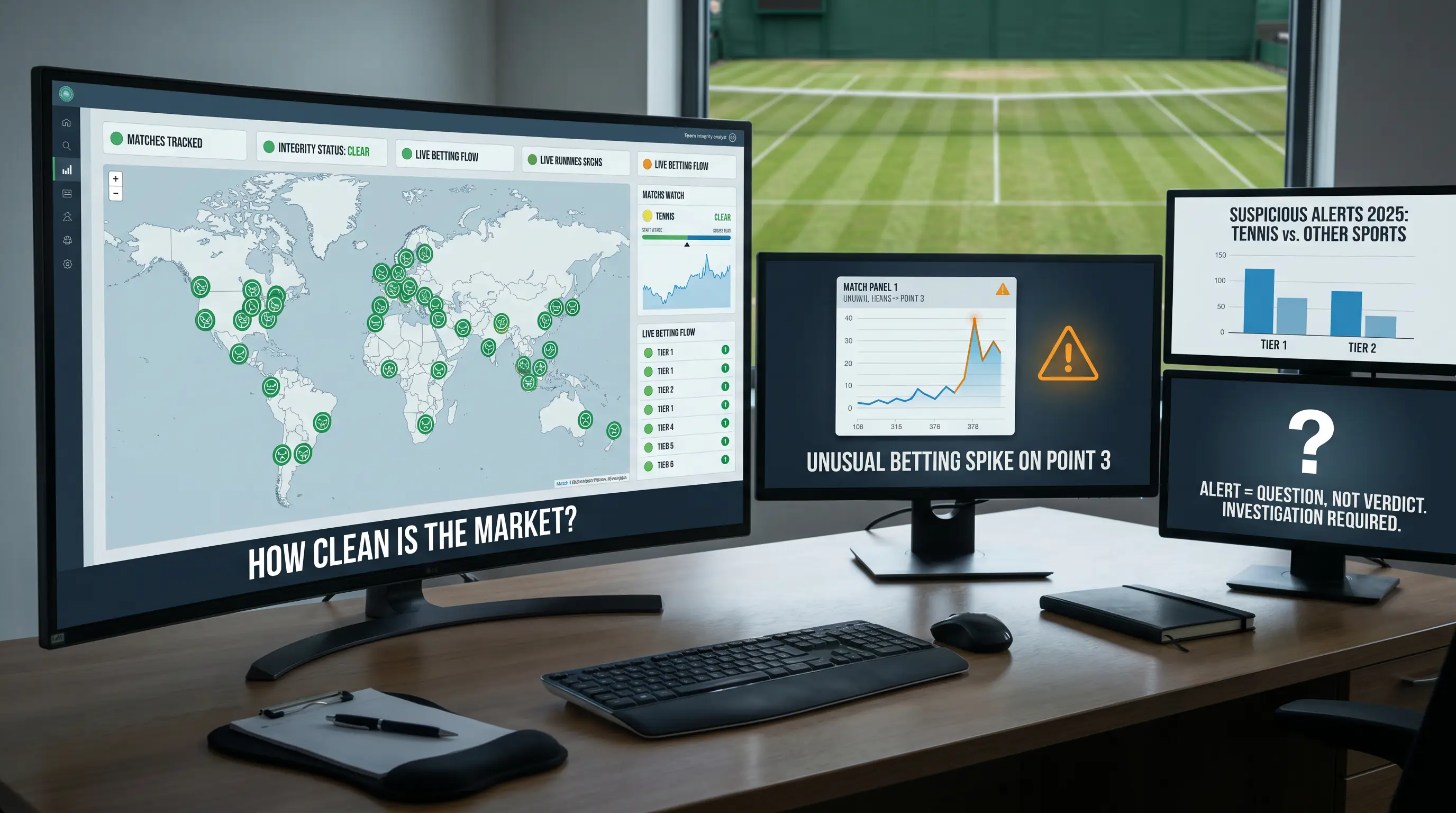
Where do alerts actually cluster? Overwhelmingly in the lower tiers of the sport, not at the majors. In the first quarter of 2025, the tennis integrity agency received nine match alerts, the bulk of them from the lowest professional rungs, the Challenger and lower-level Futures events where prize money is thin and the temptation to fix is correspondingly higher. That’s the opposite end of the sport from Wimbledon. The matches that trigger most alerts are played in near-empty venues for tiny rewards, watched by almost no one, which is precisely the obscurity a fix needs. The brighter the stage, the rarer the alert.
The economics behind that clustering are worth spelling out, because they explain the pattern rather than just describing it. A player ranked deep in the hundreds, grinding through Futures events, might earn less from winning a match than a corrupt approach offers them to lose one. The maths of temptation is brutal at that level. At the top of the game, where a single Wimbledon title pays out a record £3 million and even a first-round loser collects a five-figure cheque, the calculus inverts completely: no plausible fixing payment competes with what’s legitimately on offer, and the reputational and career cost of getting caught is catastrophic. Corruption follows the money, and at the elite level the legitimate money is simply too large for the corrupt money to compete.
For a Wimbledon bettor, this is the reassuring part, and it’s why understanding the markets themselves matters more than worrying about ghosts. If you’re betting the show courts, you’re betting the most scrutinised matches in the sport, and an integrity flag on one of those is vanishingly rare. The mechanics of placing those bets sensibly is its own subject, and the foundations are laid out in the guide to how to bet on Wimbledon.
From alert to sanction
An alert is a question. A sanction is an answer, and the path between them is long, evidence-led and deliberately cautious, which is exactly as it should be when a person’s career is at stake. Most alerts never become sanctions, because most alerts turn out to have innocent explanations. But when the evidence is there, the consequences are severe.
The data underlying enforcement gives a sense of the funnel. Integrity intelligence in 2025 contributed to confirming 54 instances of match-fixing and to sanctions against 24 players, teams and officials across five sports. Set that against the more than a million events monitored and the picture is clear: confirmed fixing is rare, but real, and the system that catches it depends on the same betting-market surveillance that flags the alerts in the first place. The alert is the smoke; the investigation looks for the fire; and only a fraction of smoke turns out to have any.
The sanctions, when they land, are not gentle. In the final quarter of 2025, the tennis integrity agency handed down bans including a 20-year suspension and a 12-year suspension for corruption offences. Those are career-ending penalties, and they’re meant to be, because the deterrent only works if the cost of fixing dwarfs the payoff. A player weighing a corrupt approach against a two-decade ban is, the system hopes, a player who walks away.
What keeps the process credible is that each case is judged on its own merits rather than processed by formula. The head of the tennis integrity agency has emphasised that “every case is considered in line with the individual facts and circumstances,” which is why investigations take time and why an alert never automatically becomes a charge. That caution protects the innocent player flagged by a bookmaker’s pricing error as much as it builds the case against the guilty one. The slowness isn’t a weakness in the system. It’s the feature that stops alerts from becoming convictions.
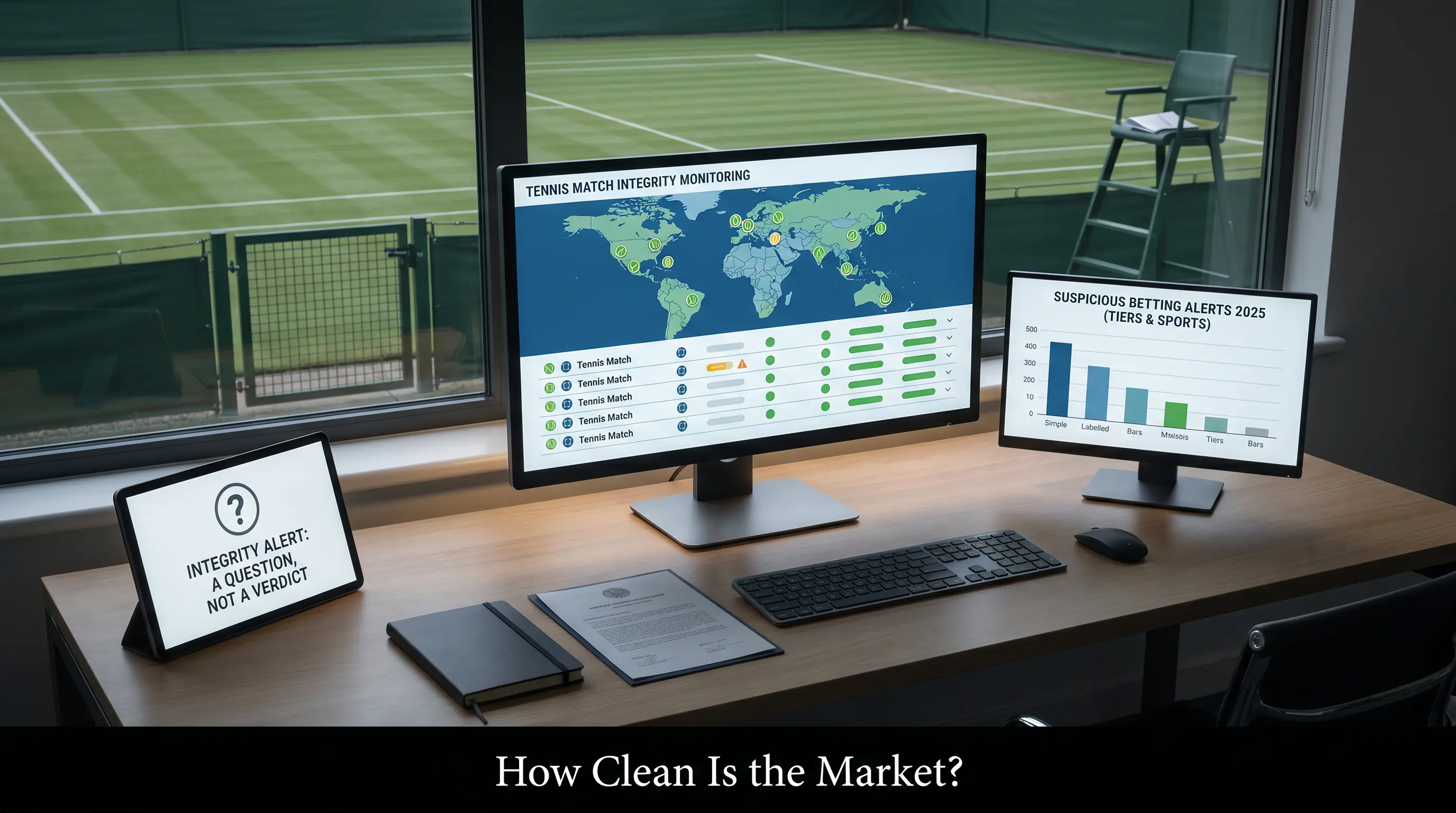
For you, the practical takeaway is calm. The enforcement machinery is real, it works, and it concentrates its attention exactly where the risk concentrates, in the lower tiers. The matches you’re betting at Wimbledon sit at the safe end of that spectrum, protected by the same scrutiny that makes them so hard to manipulate in the first place.
There’s a reason the bans run to decades rather than months, and it’s worth dwelling on because it tells you how seriously the sport takes the threat. Tennis is unusually exposed to corruption, as we’ve seen, because a single individual can deliver a fixed result, so the deterrent has to be punishing enough to outweigh the relative ease of the act. A team-sport fix requires conspiracy and risks exposure from within; a tennis fix requires only one willing player. The sanctions are calibrated against that asymmetry. A 20-year ban isn’t vindictive, it’s the calculated price the sport sets on the temptation, high enough that a rational player calculates the corrupt approach simply isn’t worth it.
Betting responsibly: the UK picture
Integrity is about whether the game is honest. Responsible gambling is about whether your betting stays healthy, and the second matters far more to your daily life than the first ever will. After nine years in this world, I’m certain of one thing: the bettors who last are the ones who treat staying in control as a skill to practise, not a warning to ignore.
Betting is a normal, mainstream activity in Britain, and the scale of it sets the context. In 2024, 48% of adults reported gambling in the previous four weeks, falling to 28% once people who only play the lottery are stripped out. Betting specifically reaches a meaningful slice of the population: research found that almost a quarter of UK adults, 24%, bet on sport online every month, a figure that climbs to 52% among those aged 25 to 34. Online gambling continues to grow, with the online gross gambling yield rising 7% year on year to £1.45 billion in the first quarter of 2025, drawn from an average of 13.5 million active accounts each month. You are, in short, far from alone in betting on Wimbledon, and the activity is regulated precisely because it’s so widespread.
That scale carries a duty, and Wimbledon’s particular shape sharpens it. A fortnight of continuous, compelling tennis is a fortnight of continuous temptation, fourteen days of matches each offering a fresh reason to bet. The risk isn’t a single bad bet. It’s the slow creep of a daily habit across two weeks, each day’s losses chasing the last. The data underlines why this deserves attention: the Gambling Commission has found that 8% of 11 to 18-year-olds encountered online gambling in a year, a reminder that the activity reaches people it shouldn’t and that the guardrails exist for good reason.
The tools to stay in control are built into every licensed UK site, and using them is a mark of a smart bettor, not a worried one. Deposit limits cap what you can put in over a day, week or month, and I set mine before the Championships begin, when my judgement is cool, not in the heat of a fourth set. Time-outs lock you out for a chosen period. Reality checks ping you with how long you’ve been betting and how much you’ve staked. Self-exclusion, the strongest tool, blocks your access across operators for a set period when betting has stopped being fun. None of these are admissions of a problem. They’re the equipment of someone who intends to still be enjoying this next year.
The single habit I’d press on any Wimbledon bettor is the one from the workflow: set your limits before you deposit, and decide your fortnight budget as a whole, not match by match. Betting responsibly isn’t a disclaimer to skim past. It’s the discipline that lets the fortnight stay what it should be, an enjoyable layer on top of the best grass-court tennis in the world, rather than something you come to dread. If at any point it stops being enjoyable, the tools are right there, and reaching for them is the most expert move you can make.

Does a betting alert mean a Wimbledon match was fixed?
No. An alert is a flag that the betting activity on a match looked unusual enough to investigate, not proof that anything improper happened. Integrity bodies are explicit that an alert is not in itself evidence of fixing, and unusual patterns frequently turn out to stem from mistaken odds-setting, informed betting on a known injury, or a shift in a player’s form and fatigue. It marks a question, not a verdict.
Why do lower-tier events trigger more alerts than Grand Slams?
Because fixing needs obscurity, and the lower tiers provide it. Challenger and Futures events offer thin prize money, light betting volumes and almost no spectators, which makes them both more tempting to corrupt and easier to manipulate without standing out. A Grand Slam match sits under enormous, transparent betting volumes where any anomaly is obvious instantly, so alerts there are vanishingly rare.
Where can a UK bettor find safer-gambling tools?
Every licensed Great Britain operator is required to offer them directly in your account: deposit limits, time-outs, reality checks and self-exclusion. The strongest habit is to set a deposit limit and a whole-fortnight budget before you fund the account, while your judgement is calm. Self-exclusion can block access across operators for a chosen period if betting stops being enjoyable.
