
 Available in US
Content
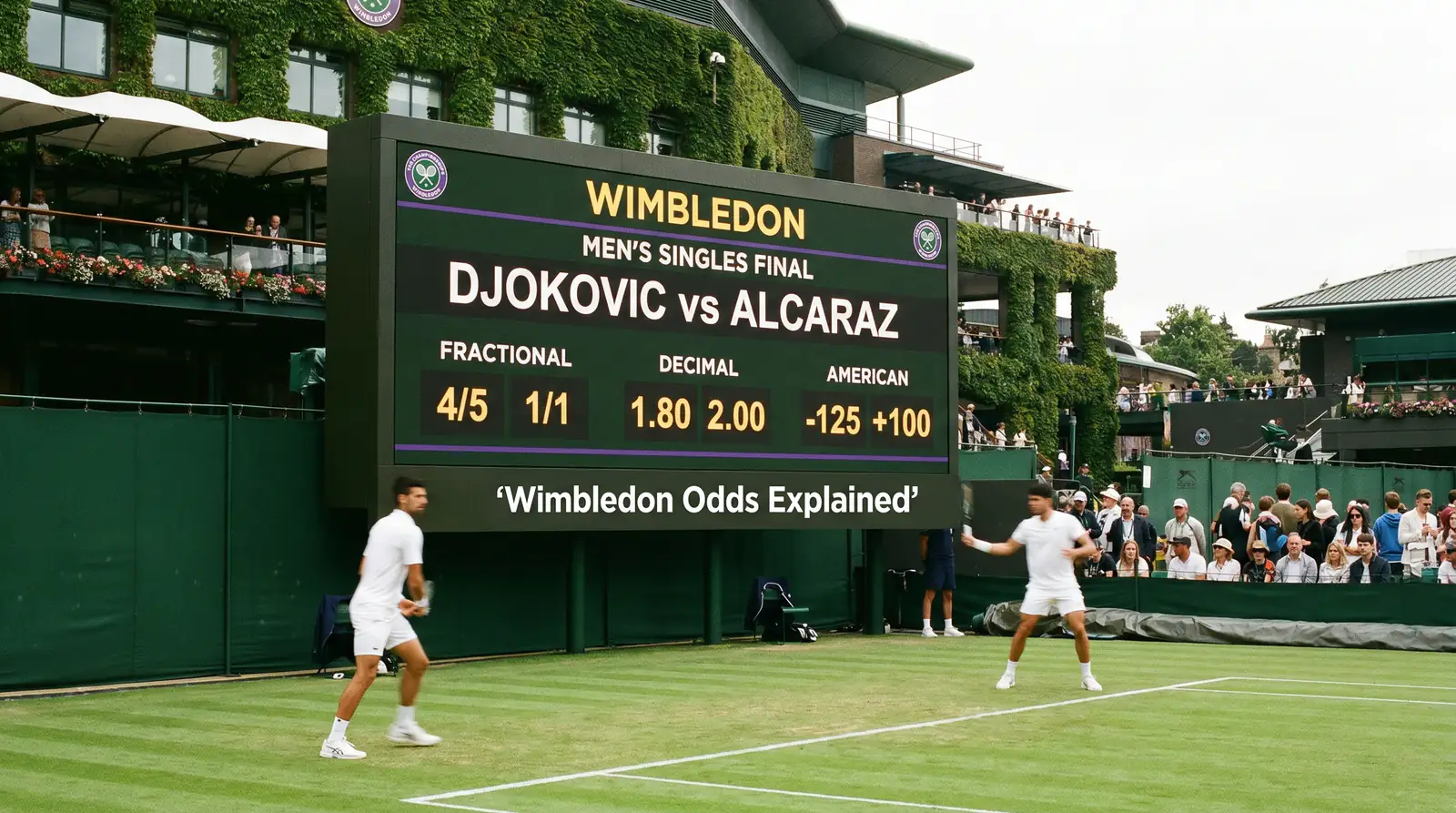
What the numbers next to a player actually mean
For my first two years betting on Wimbledon, I thought the number next to a player was the bookmaker’s prediction. If it said 2.00, I figured the book reckoned it was a fifty-fifty match. I was wrong in a way that quietly cost me money every single time I backed a favourite, and it took an embarrassingly long while to work out why.
Here’s the truth that reframes everything: the price next to a player is not a probability. It’s a probability with a tax bolted on, and the tax goes to the bookmaker. Until you can see both parts of that number, the real chance underneath and the margin sitting on top, you’re reading the menu without noticing the service charge. You can still order, but you’ll never know if you’re being overcharged.
This guide pulls those numbers apart. We’ll start with the three ways odds are written, because a UK book and an American app will show you the same bet in formats that look nothing alike. Then we’ll turn a price into a probability, which is the single most useful skill a tennis bettor can own. After that, the bit nobody likes talking about: the hidden margin, how to measure it, and how to strip it out to find the fair price. Get through this and you’ll never again look at a Wimbledon match and confuse “the favourite” with “good value.”
None of this is advanced maths. It’s arithmetic you can do on a phone calculator between points. But it’s the arithmetic that turns a punter into a bettor, so let’s do it properly.
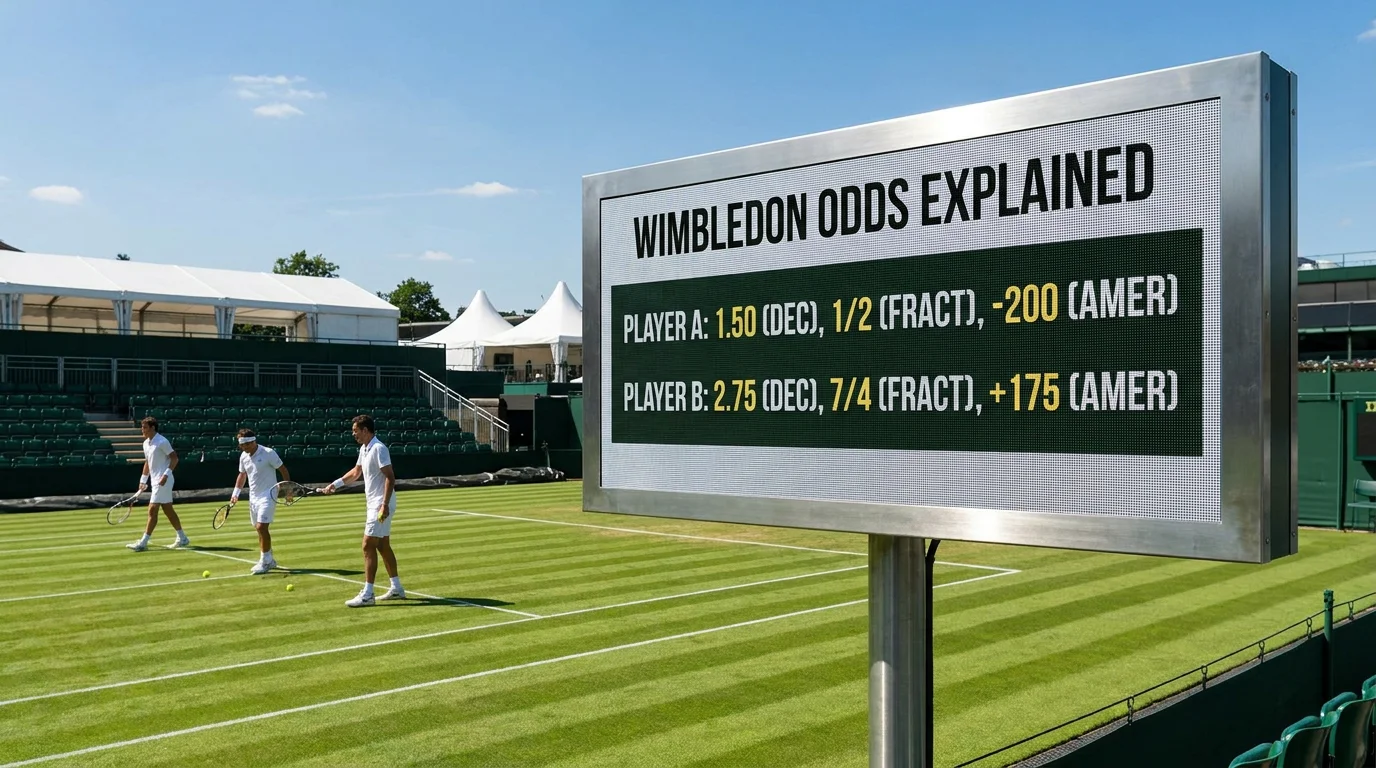
Decimal, fractional and American side by side
Walk into a betting shop in Britain and you’ll see fractions. Open an American sportsbook and you’ll see plus and minus signs. Load a sharp’s spreadsheet and it’s all decimals. Same bets, three dialects, and the inability to translate between them is the first thing that makes new bettors feel out of their depth. It shouldn’t, because they all say the same thing.
Decimal odds are the cleanest, which is why analysts and exchanges prefer them. The number is your total return per unit staked, your stake included. Decimal 2.50 means a £10 bet returns £25 in total: £15 profit and your £10 back. To find profit, subtract one from the decimal and multiply by your stake. Decimal 1.40 returns £14 on £10, so £4 profit. The higher the number, the longer the odds and the bigger the underdog. There’s nothing to memorise. You just read it.
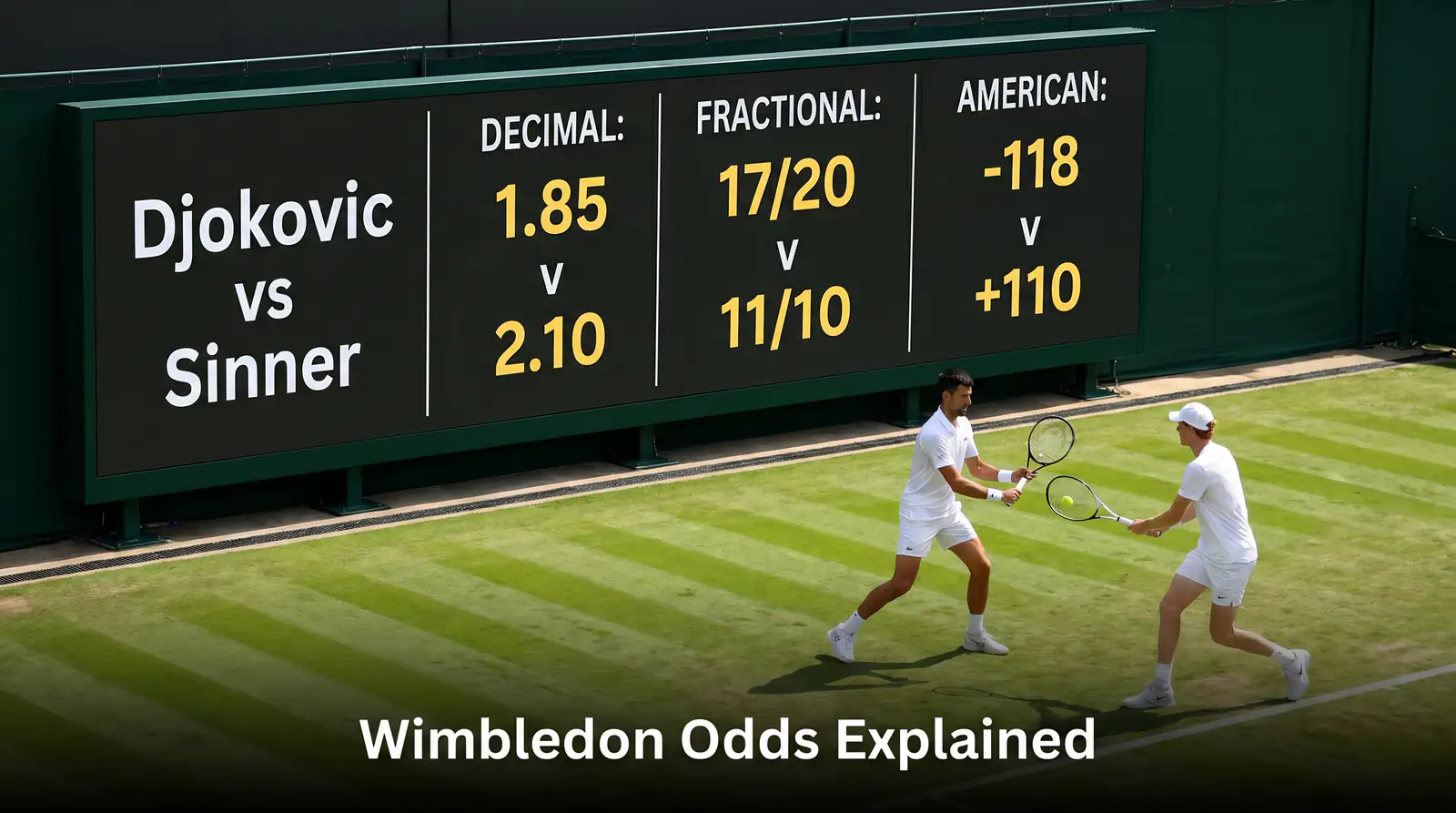
Fractional odds are the British tradition, and Wimbledon being a British institution, you’ll see them everywhere during the fortnight. The fraction tells you profit relative to stake. So 6/4 means you win six pounds for every four staked, which on a £10 bet is £15 profit, returning £25 total. Notice that’s identical to decimal 2.50, because it is the same bet. The mental hurdle is that fractions don’t include your stake in the headline number, so 6/4 and decimal 2.50 look different but mean exactly the same thing. Are fractions outdated? A little. But they’re still the default on plenty of UK sites, so you need to read them fluently.
American odds turn up on US-facing apps and in a lot of betting content written for that market. They pivot around 100. A positive number, say +150, tells you the profit on a 100-unit stake: bet 100, win 150. A negative number, say -200, tells you how much you must stake to win 100: risk 200 to win 100. The favourite carries the minus, the underdog the plus, and the even-money point is +100 or -100. It’s the format Brits find most alien, but the logic is consistent once you anchor on that 100.
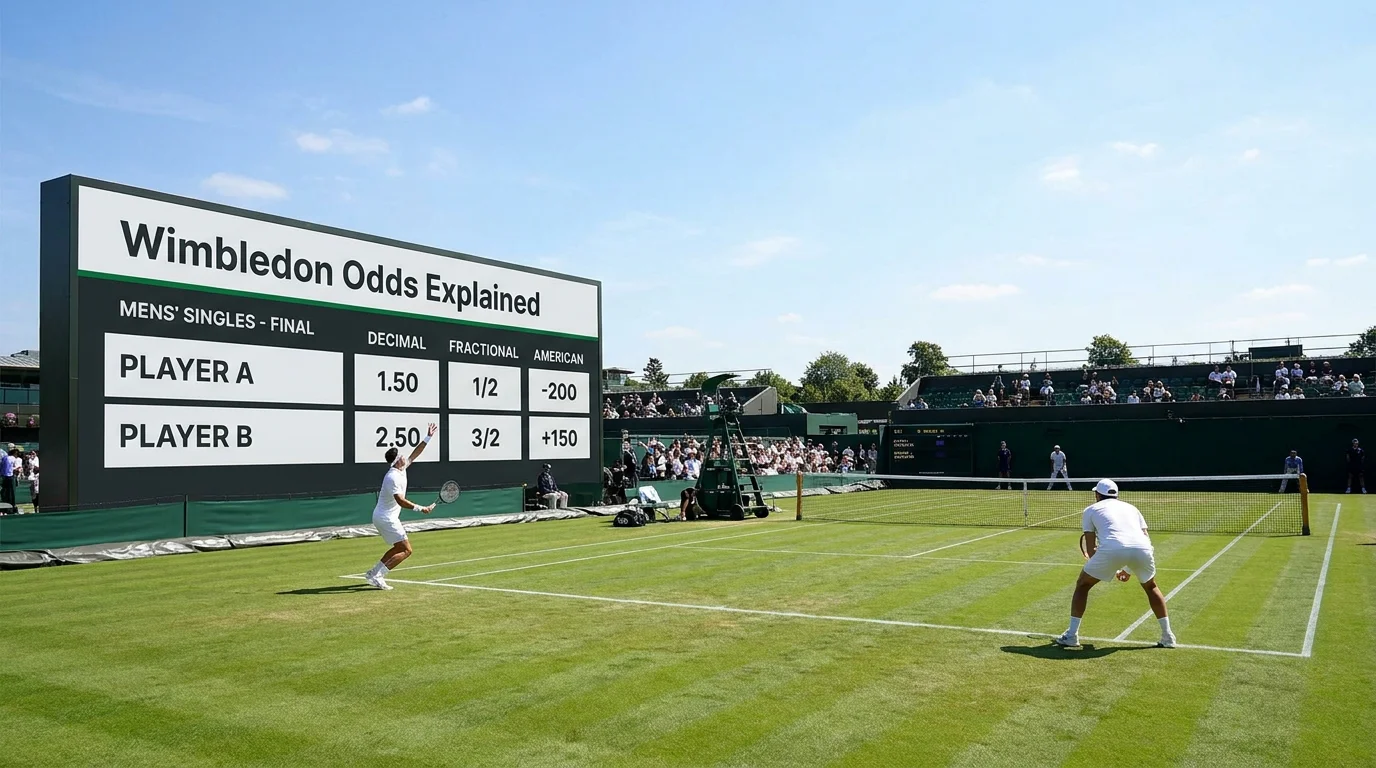
Let me line up one bet in all three so the equivalence is undeniable. An even-money shot, a true coin flip, is decimal 2.00, fractional evens or 1/1, and American +100. A clear favourite might be decimal 1.40, fractional 2/5, American -250. A solid underdog could be decimal 3.50, fractional 5/2, American +250. Once you can glance at any of these and feel the others, the format stops mattering and the price starts talking. My advice for a UK bettor: think in decimals when you’re calculating, because the arithmetic is trivial, and read fractions because that’s what the screen shows you during Wimbledon.
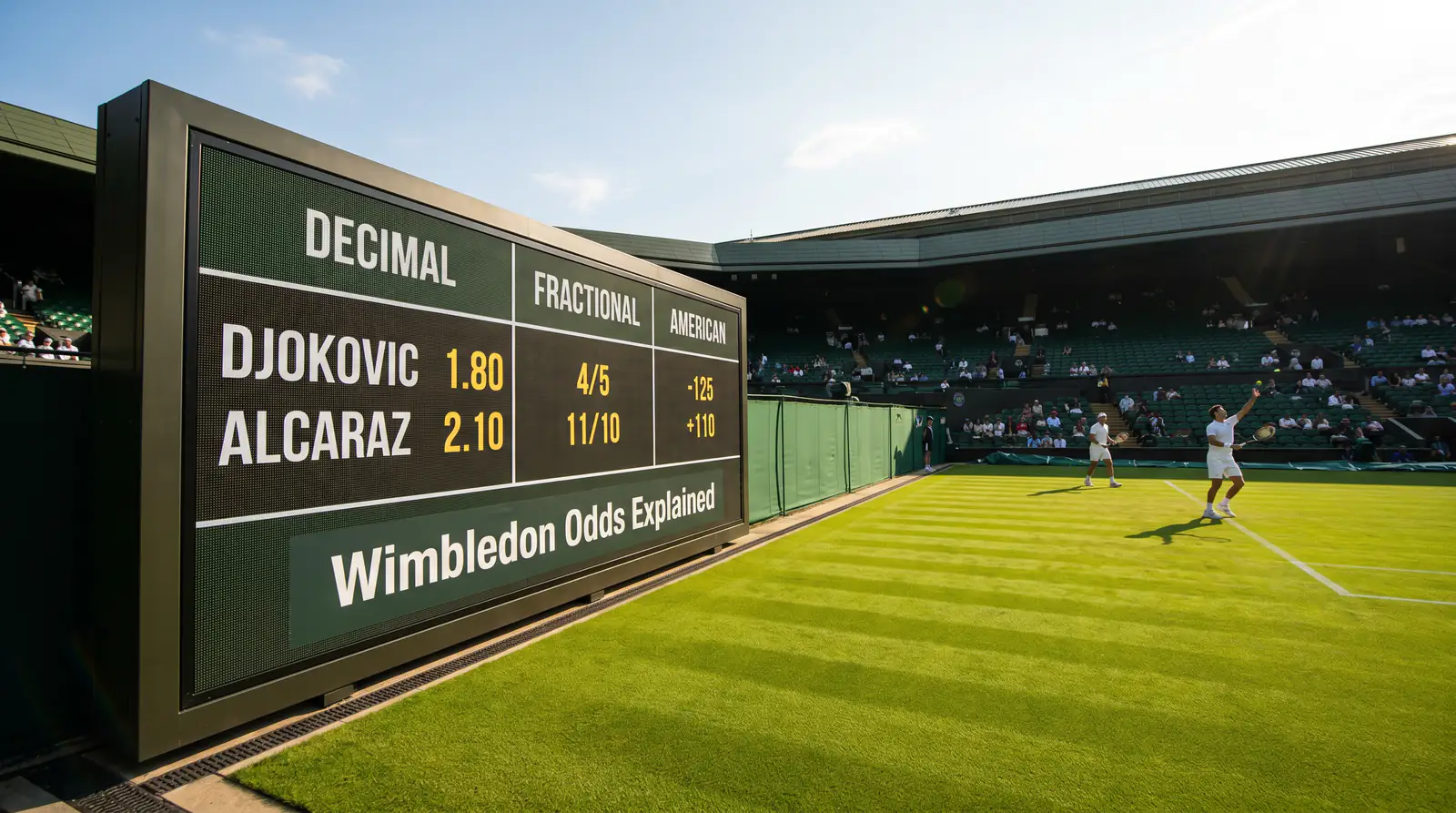
Turning odds into implied probability
This is the conversion that changed how I bet, and I’ll give you the formula before I give you the story, because it’s that simple: implied probability equals one divided by the decimal odds. That’s the whole trick. Decimal 2.00 becomes 1 divided by 2, which is 0.50, or 50%. Decimal 1.40 becomes 0.714, roughly 71%. Decimal 4.00 becomes 0.25, or 25%.
What you’ve just calculated is the chance the bookmaker’s price implies. It answers the only question that matters when you’re deciding whether to bet: how likely does this number say the result is? Once you can read a price as a percentage, you can compare it against your own estimate of the real chance. If the price implies 71% and you think the player wins more like 80% of the time, you’ve found value. If the price implies 71% and you think it’s nearer 60%, you walk away. Value betting is nothing more than this comparison, repeated with discipline.
Here’s why it’s transformative for a beginner. Without this step, you’re judging bets by gut feeling about whether odds “look good.” With it, you’re judging them against a number you derived yourself. A short price on a Wimbledon favourite might feel unexciting, but if it implies 75% and the player genuinely wins four times in five on grass, it’s a better bet than a thrilling long shot whose implied chance you never bothered to check. The conversion drags the decision out of the realm of feeling and into the realm of arithmetic, which is exactly where you want it.
It also inoculates you against the most expensive instinct in betting: the love of a big number. Long odds are seductive because the potential return is large, but the implied probability tells you the cold truth about how rarely that return will arrive. A 7.00 shot implies a 14% chance, which means it loses six times out of seven even when the price is perfectly fair. Knowing that before you bet stops you romanticising the underdog and starts you asking the only useful question: is the real chance higher or lower than 14%?
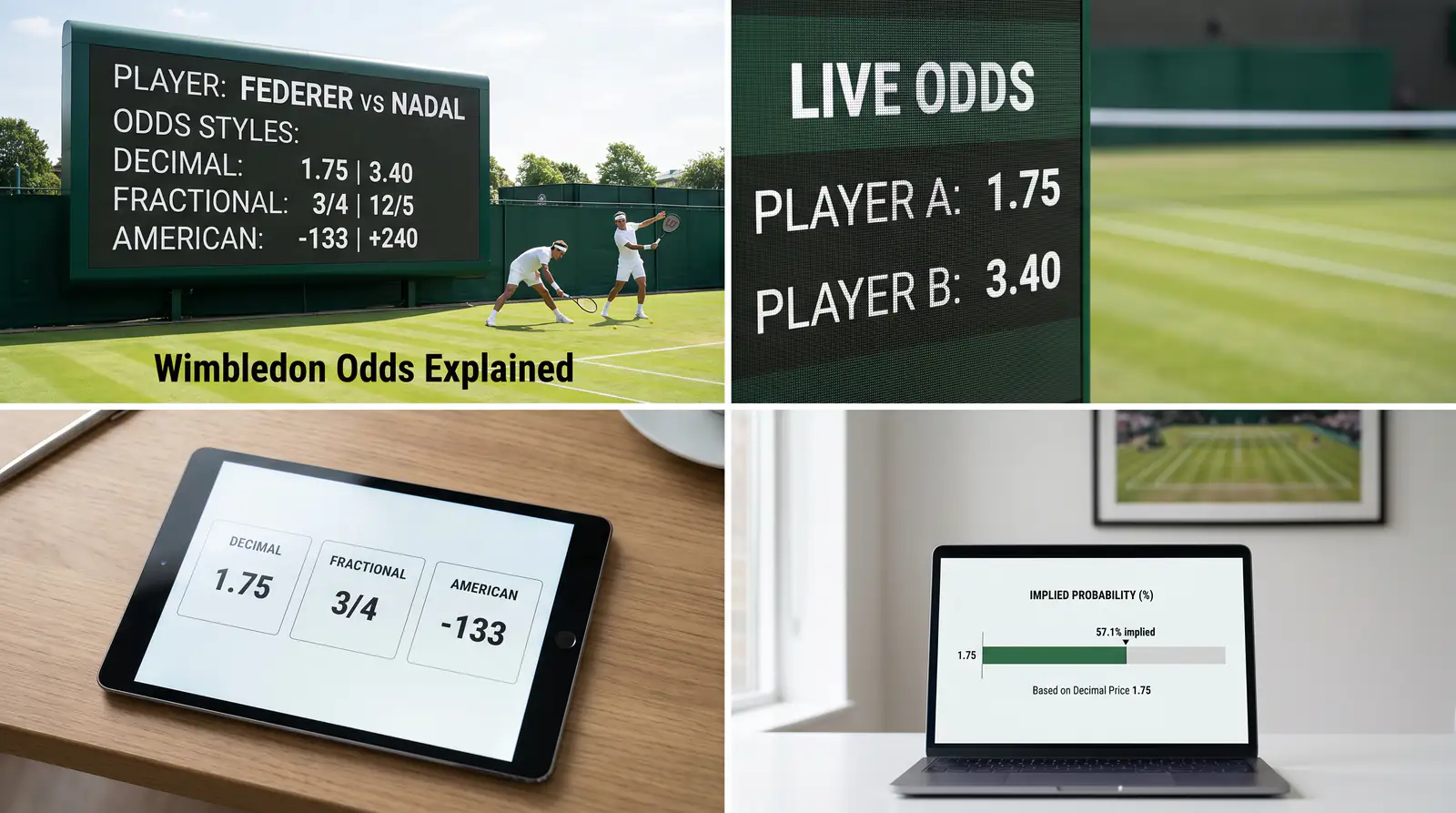
Now the part that surprises people. Add up the implied probabilities of both players in a single match and you’ll get a number bigger than 100%. Take a match priced 1.40 and 3.00. The favourite implies about 71%, the underdog about 33%, and 71 plus 33 is 104%. But the two players can’t have a combined 104% chance of winning, because between them they have exactly a 100% chance. One of them wins. Always.
That extra four percent isn’t an error. It’s the bookmaker’s margin, sitting in plain sight, and it’s the single most important thing on the page once you know to look for it. Every implied probability you calculate is inflated by it. The number the price gives you is always a little higher than the real chance, because the book has padded it. Which is exactly the problem the next section solves.
The hidden margin: vig and overround
A bookmaker is not a fortune teller. It’s a business that takes a cut, and that cut has a name, several in fact. In the UK we tend to call it the overround. Americans call it the vig, short for vigorish, or sometimes the juice. They’re the same thing: the built-in edge that guarantees the book a profit if it balances its book, regardless of who wins.
You met it at the end of the last section as that 104%. The amount over 100% is the overround. In our example, the margin is four percent. That four percent is what the book expects to keep, on average, across everyone betting that match. It’s the price of doing business with them, and you pay it on every single bet whether you realise it or not.
Calculating it from a two-way price is straightforward, and you should get into the habit. Convert both odds to implied probability, add them, subtract 100%. For our 1.40 and 3.00 match: 71.4% plus 33.3% is 104.7%, so the margin is 4.7%. A tighter market, say 1.91 and 1.91 on a true coin flip, gives 52.4% plus 52.4%, a margin of 4.8%. The lower that final figure, the more generous the book, because it’s keeping less for itself and handing more of the true price back to you.
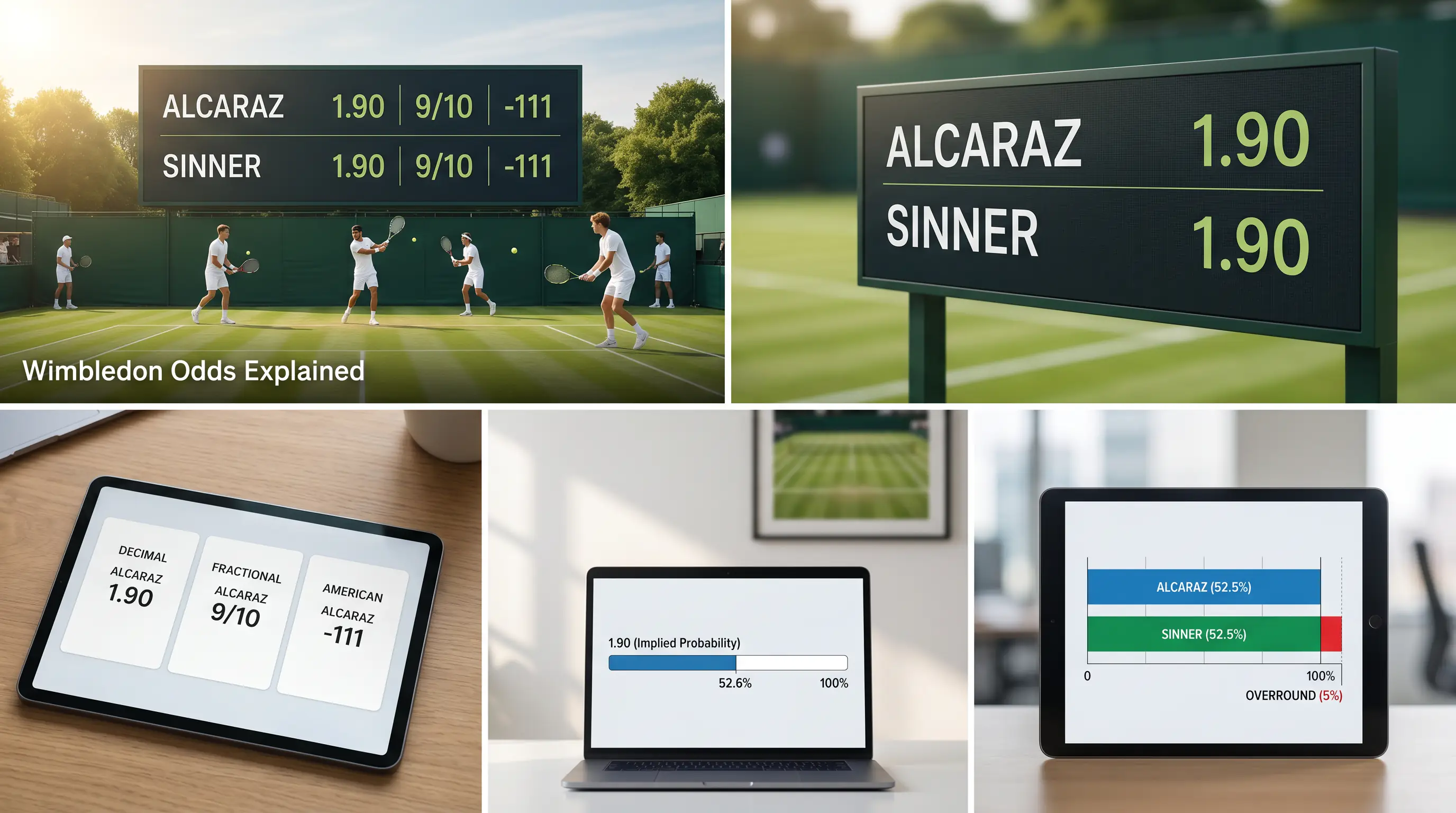
Why should a Wimbledon bettor care about a few percent? Because it compounds, and because it varies. The margin a book charges on a marquee Centre Court match might be slim, since the volume of money keeps it competitive. The margin on an obscure first-round contest, or on an exotic market like correct score, can be brutal, often well into double digits. You bleed value fastest in exactly the markets that feel most exciting, which is no coincidence at all.
Tennis sits at the centre of a vast and closely watched betting market, and that scale shapes where margins land. The sport draws so much wagering attention that it generated 74 of the suspicious-betting alerts logged by one major integrity association in 2025, a quarter of all alerts across every sport they monitor, which tells you something blunt: enormous volumes of money move through tennis markets, and books price the high-traffic matches keenly to capture that turnover. The flip side is that the quiet matches, the ones nobody’s watching, carry fatter margins precisely because the book faces no competitive pressure to sharpen them. Where the money flows, the price tightens. Where it doesn’t, you pay more.
The practical lesson stacks neatly on top of that. A 5% margin sounds small until you realise you pay it on every bet you place, win or lose, for as long as you keep betting. Over a fortnight of Wimbledon, across dozens of bets, that drip becomes a flood. Two bettors with identical judgement, one paying 3% margins and one paying 7%, will end the Championships in very different places, and neither of them will have made a single different prediction. The margin alone separates them.
The discipline is this: the margin is a cost, and like any cost you want to minimise it. A bettor who ignores the overround is a bettor paying full retail on every purchase, every time, forever. A bettor who measures it knows when they’re being charged a fair price and when they’re being fleeced. That knowledge is worth more than any tip, because a tip is a single bet and the margin is every bet you’ll ever make.
No-vig fair odds and why they matter
If the margin is the tax, the no-vig price is what the bet would cost in a world without one. It’s the bookmaker’s genuine opinion of the match, stripped of the cut they’ve added to make a living. And here’s the quietly powerful idea: the no-vig price is one of the best estimates of true probability you’ll ever get for free. The market, especially a deep one like a Wimbledon main draw, is a brutally efficient aggregator of information. Remove the margin and what’s left is the crowd’s best collective guess.
Calculating no-vig odds is a two-step move once you’ve got your implied probabilities. Take both implied figures, add them to get the overround total, then divide each one by that total. It re-scales the two numbers so they sum to exactly 100%, which is what real probabilities must do. Run our 1.40 and 3.00 match through it: 71.4% and 33.3% sum to 104.7%. Divide 71.4 by 104.7 and you get 68.2%. Divide 33.3 by 104.7 and you get 31.8%. Those two now add to 100, and they represent the book’s true read: the favourite around 68%, not the inflated 71% the raw price implied.
So what do you do with a fair price? You use it as a ruler. When you back a player at one book, you want to know whether the price you’re getting is better or worse than the fair price implied by the wider market. If you can find a price whose implied probability is lower than the no-vig fair probability, you’ve found genuine value, because you’re getting paid as if the result were less likely than the market’s own best estimate says it is. Beating the fair price, consistently, is the entire game for a serious bettor.
This is also the cleanest way to compare an underdog bet to a favourite bet, which otherwise feel incomparable. Strip both to their fair probabilities and they speak the same language. A 31.8% underdog and a 68.2% favourite are just two ends of the same coin, and your only question is which side the book has mispriced relative to that fair line. The mechanics of removing the margin entirely deserve a fuller walkthrough, but the core skill, re-scaling two prices so they sum to a true 100%, is exactly what you’ve just done, and it’s worth practising on every match you consider.
One honest caveat. The fair price is an estimate, not gospel. It’s the market’s opinion, and markets are wrong sometimes, which is precisely why value exists. But it’s a far better starting point than your gut, and it’s the foundation on which every disciplined approach to Wimbledon betting is built.
Comparing prices across bookmakers
The single most reliable edge available to an ordinary bettor isn’t a system or a tipster. It’s refusing to accept the first price you see. Different books price the same Wimbledon match differently, sometimes trivially, sometimes by a margin that turns a losing strategy into a winning one over a season. Taking the best available price is free money, and most people leave it on the table out of pure laziness.
Why do prices differ at all? Because pricing tennis is hard, and books disagree. The data underpinning these markets has become extraordinarily sophisticated. The infrastructure behind point-by-point feeds consolidated dramatically when one of the major data firms acquired a rival’s portfolio of betting rights for £225 million, folding tennis into a single pipeline of granular, real-time information. That feed standardises a lot, but books still apply their own models, their own risk appetites, and their own margins on top, so the final numbers diverge. Two books looking at the same match through the same data can still arrive at meaningfully different prices.
The scale of the market is what makes this worth your time. Live and in-play betting alone made up over 62% of the online sports betting market in 2025, and tennis is a huge slice of that, which means books compete hard for tennis turnover and prices move constantly. A match-winner line you saw at lunchtime can be a different number by the time the players walk out, as money moves and books adjust. Shopping around isn’t a one-off check, it’s a habit you build into every bet.
The monitoring built around this market gives you a sense of just how much money is in play, and why books take pricing so seriously. One integrity body alone watches over 1.5 million matches a year across more than 80 sports, covering wagering volumes north of £300 billion. That’s the ocean your single Wimbledon bet drops into, and it explains why the prices on heavily traded matches are so hard to beat: thousands of sharp eyes and vast sums of money are correcting them in real time. The corollary is the opening for you. A market that big and that scrutinised on the show courts becomes thin and lazy in the backwaters, and the gap between a sharp price and a soft one is exactly the gap a price-comparing bettor lives in.
There’s a deeper point here that the integrity world makes well. As the head of one betting integrity association has noted, higher alert volumes in mature markets “often indicate stronger detection capability rather than higher inherent risk.” The same logic applies to pricing: the most scrutinised, highest-volume markets, the ones on the show courts, tend to be the sharpest and most accurate, because so much attention and money flows through them. The fat margins and the soft prices live in the quieter corners, the obscure props and lower-profile matches, where fewer eyes mean lazier lines. That’s a double-edged sword. Soft prices mean opportunity, but they also mean less liquidity and wider margins, so you trade one risk for another.
My practical routine, every Wimbledon: hold accounts at several licensed books, check at least two or three before placing any bet of size, and never, ever take a price without knowing whether a better one exists elsewhere. It’s unglamorous. It’s also the closest thing to a guaranteed edge that betting offers, and once you’ve internalised the relationship between price, probability and margin, comparing books is simply the act of putting all that knowledge to work. Where the surface itself starts to shift these calculations, the grass-court betting strategy picks up the thread.
Why do two bookmakers show different odds for the same Wimbledon match?
Each book runs its own pricing model, sets its own margin and manages its own risk, so even when they draw on the same point-by-point data feed they arrive at different numbers. Prices also move at different speeds as money comes in. That divergence is exactly why comparing books before you bet is one of the few reliable edges available.
How do I calculate the bookmaker’s margin from a two-way price?
Convert each price to implied probability by dividing one by the decimal odds, add the two percentages together, then subtract 100. The leftover figure is the overround. A two-way market summing to 104.7% carries a 4.7% margin, and the lower that number, the more generous the book is being to you.
Are fractional odds still standard at UK bookmakers?
They remain common, especially on traditional UK sites and during a British institution like Wimbledon, but most sites now let you switch the display to decimal. For calculating probability and margin, decimal is far easier to work with, so many bettors read fractions on screen and convert to decimal in their head.
