
 Available in US
Content

The price with the margin stripped out
The first time someone showed me how to strip the margin out of a tennis price, I felt slightly cheated — not by them, by every bookmaker I had ever used. I had spent years comparing the headline odds on a match without realising that the two prices, added together, told me exactly how much the book was skimming off the top. Once you see it, you cannot unsee it.
No-vig odds, sometimes called fair odds, are what the prices on a match would be if the bookmaker took no profit margin at all. The “vig” — short for vigorish, also called juice or the overround — is the cut the book builds into its prices to guarantee a profit regardless of the result. Calculating the no-vig price reveals the market’s true estimate of each player’s chance, unclouded by that built-in margin.

This is not an academic exercise. The no-vig price is the benchmark every serious bettor measures real prices against, because it tells you what the market actually thinks before the bookmaker’s tax is applied. Get comfortable with it and you have a tool for spotting value that most recreational bettors never pick up.
What vig is and where it sits
Start with a coin toss. A fair price on heads is 2.00, and a fair price on tails is 2.00, because each has a fifty percent chance. Convert those to implied probabilities and they sum to exactly 100 percent. That is a market with no margin — and you will never see one at a bookmaker.

What a bookmaker actually does is shorten both prices, so heads and tails might be offered at 1.91 each. Convert those to implied probabilities and they sum to more than 100 percent — around 104.7 percent in this case. That extra 4.7 percent is the vig, the overround, the bookmaker’s built-in edge. It guarantees that if betting is balanced on both sides, the book pays out less than it takes in no matter who wins. Every tennis market carries this overround, and the size of it varies by book and by market — tight on a heavily traded Centre Court match, far steeper on an obscure prop or a longshot outright.
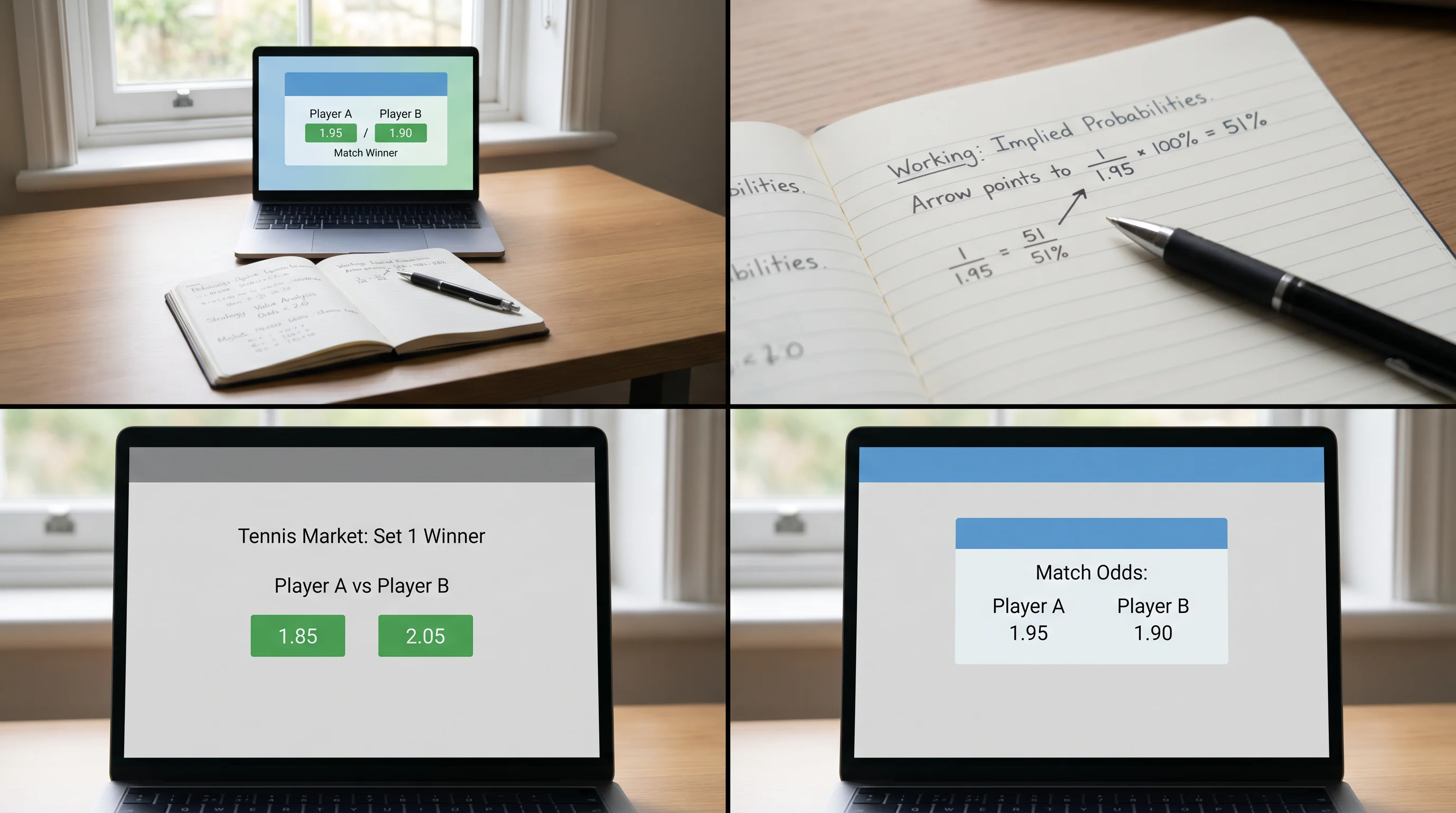
The crucial insight is that the overround is hidden inside the prices you see. The headline odds on a match are not the market’s true probability estimate; they are that estimate plus a margin. To find what the market really thinks, you have to remove the margin, and that is exactly what the no-vig calculation does.
Calculating no-vig odds step by step
The method is simple arithmetic, and you can do it on the back of a betting slip. Take a two-way market — say a match priced at 1.50 for the favourite and 2.60 for the underdog. First, convert each price to an implied probability by dividing one hundred by the decimal odds: the favourite is 100 divided by 1.50, or 66.7 percent, and the underdog is 100 divided by 2.60, or 38.5 percent.
Add those together and you get 105.2 percent. That total above one hundred is the overround — 5.2 percent of margin in this market. To strip it out, divide each player’s implied probability by that total. The favourite becomes 66.7 divided by 105.2, or 63.4 percent; the underdog becomes 38.5 divided by 105.2, or 36.6 percent. Those two now sum to exactly 100 percent — the margin is gone. Convert them back to decimal odds by dividing one hundred by each, and you get fair prices of about 1.58 for the favourite and 2.73 for the underdog. Those are the no-vig odds: the market’s genuine estimate of each player’s chance.
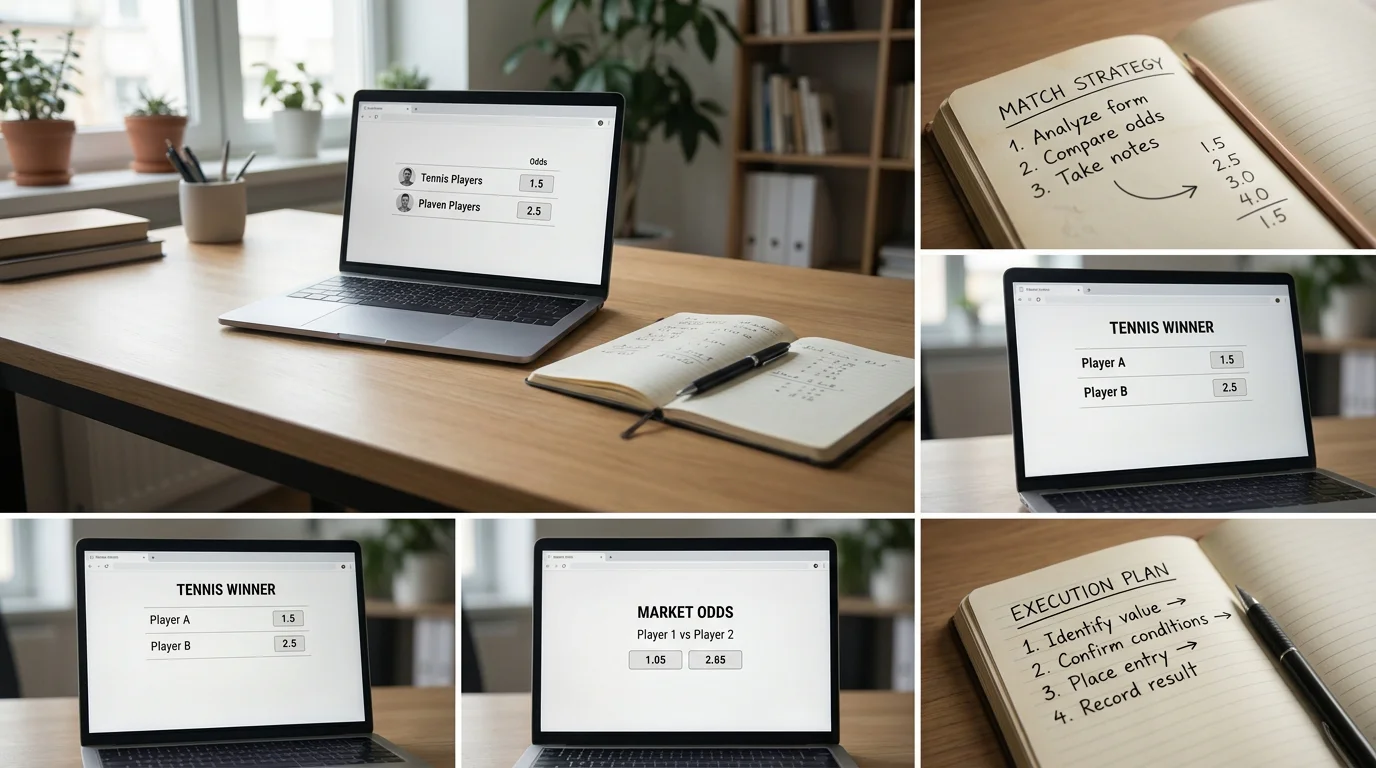
That is the whole technique. Implied probabilities, sum them, divide each by the sum, convert back. It works on any two-way tennis market, and the fair prices it produces are your yardstick for whether any actual price you can find is generous or mean.
A quick word on why this matters more in tennis than in some other sports. Tennis match-winner markets are almost always two-way — there are no draws, no ties to complicate the maths — which makes the no-vig calculation cleaner here than in, say, football with its three outcomes. That simplicity is a gift: you can strip the margin from a tennis price in your head while you watch the warm-up, and you do not need a spreadsheet to do it. The two-way structure is one of the quiet reasons tennis rewards the disciplined value bettor, because the fair price is always just a few divisions away.
Using fair odds to judge value
The no-vig price earns its keep the moment you start comparing books. Because different bookmakers set different lines, the fair prices you calculate from each will differ, and the sharpest of them — usually the highest-liquidity, lowest-margin operators — tend to produce the most accurate fair estimate of a player’s true chance. That consensus fair price is the number to beat.

Here is how I use it in practice. I calculate the no-vig price on a match from a sharp, low-margin book, then I scan the rest of the market for any actual price longer than that fair number. If one book is offering 1.70 on a player whose no-vig fair price is 1.58, that is genuine value — I am being paid as if he were less likely to win than the sharpest part of the market believes. The infrastructure behind these markets has consolidated heavily, with one major data company paying £225 million for a portfolio of betting rights that feeds point-by-point information into pricing, which means the fair prices at the top books are sharper than ever and the value increasingly hides in the gaps between them. The no-vig calculation is what turns that scattered market into a clear signal, and it is the natural foundation for the broader hunt I describe in my guide to value betting at Wimbledon.
Which bookmaker’s price is closest to no-vig?
Generally the high-liquidity, low-margin operators whose business model relies on volume rather than fat margins. Their overround on a major tennis match is the thinnest in the market, so the fair price you calculate from their odds is the most accurate estimate of a player’s true chance and the best benchmark for spotting value elsewhere.
Does the favourite or underdog carry more of the margin?
The margin is often distributed unevenly, with a larger share frequently loaded onto the underdog and longer prices. This is why longshots and outsiders tend to offer worse value than their headline odds suggest, and why stripping the vig from both sides separately, rather than assuming it splits evenly, matters when you judge a price.
