
 Available in US
Content
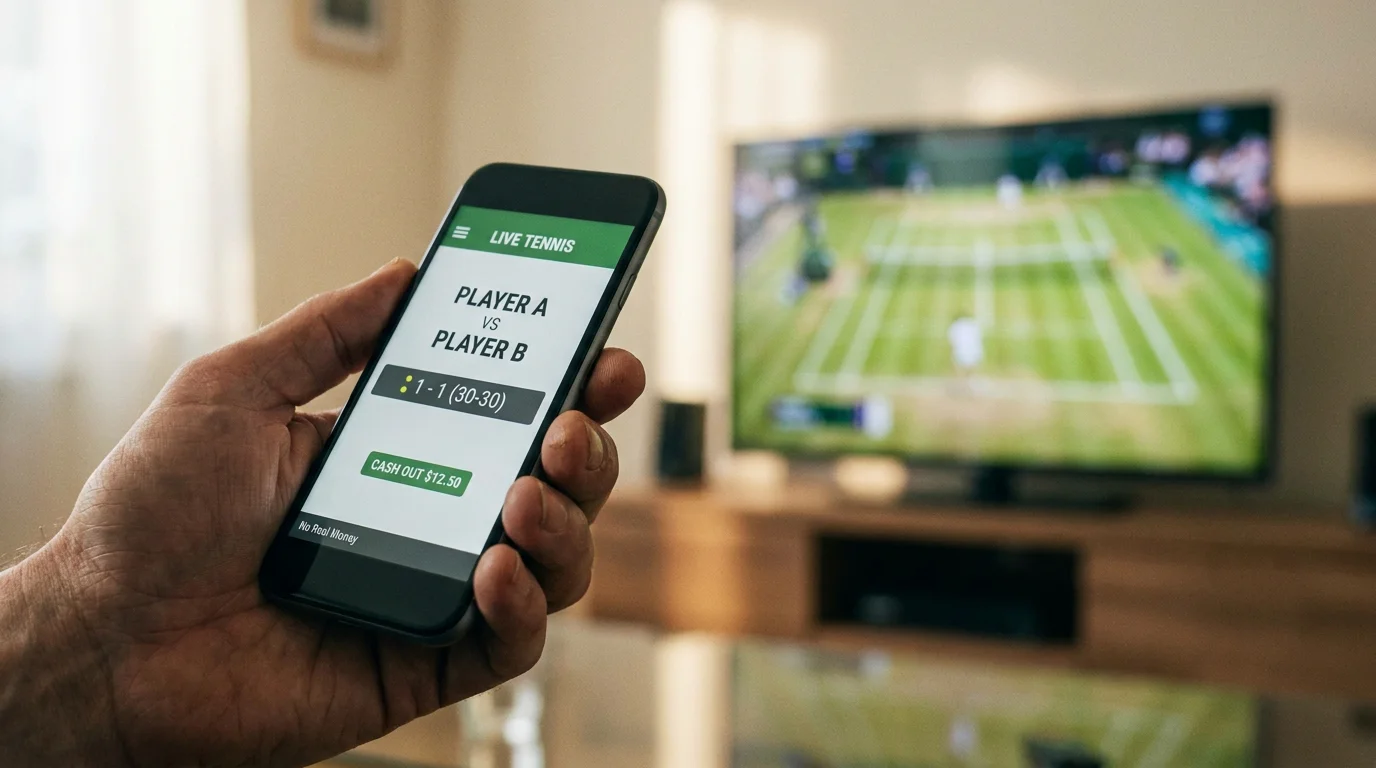
The button that costs you value
I have a confession that will surprise no one who has bet in-play: I have pressed the cash out button in a moment of panic more times than I would like to admit, and most of those times I was wrong to. The button is designed to feel like safety. It usually costs you money. Learning to treat it as the expensive convenience it is, rather than a free escape hatch, was one of the more profitable adjustments I ever made.
Cash out is a feature that lets you settle a bet before the event finishes, taking a payout calculated from the current state of play rather than waiting for the final result. Win or lose looking likely, you can take a guaranteed amount now — more than your stake if you are ahead, less than full value if you bail early. It is hugely popular, especially in the fast-moving in-play markets that dominate tennis betting, and that popularity is precisely why it deserves scrutiny.

The hard truth is that cash out is a product the bookmaker sells you, not a favour they do you. Understanding how it is priced is the only way to use it without quietly handing back your edge.
How cash out is priced
A cash-out offer is generated from the live odds of your bet’s current outcome. If you backed a player who is now winning, his live price has shortened, your bet is worth more than your stake, and the book offers you a chunk of that gain to settle now. If he is losing, his price has drifted, and the offer is a fraction of your stake to cut your losses.
The mechanism is essentially an automated hedge that the bookmaker performs on your behalf — and crucially, performs at a price that includes their margin. The cash-out figure is not the true fair value of your position; it is the fair value with the overround skimmed off. This is why cash out is so prevalent in live tennis, where in-play betting takes around 62 percent of the online sports betting market and the constant repricing of a match creates a steady stream of cash-out offers. Tennis leans on live betting more heavily than almost any sport — in some major operators close to 90 percent of tennis bets are placed in-play — so the cash-out button is being waved in front of tennis bettors more relentlessly than anyone else. Every one of those offers is a small transaction the book profits from, which tells you everything about whose interest the feature serves.
The more often you cash out, the more times you pay that margin, and those repeated tolls compound. A bettor who reflexively cashes out every winning position is running a strategy of paying the bookmaker a fee to feel safe, over and over. It is the betting equivalent of selling every share the moment it ticks up — you lock in small, certain gains while systematically capping your upside, and the cumulative cost of all that caution is far larger than any single cash-out fee suggests.
The margin baked into cash out
The single most important thing to understand about cash out is that the offer is almost always worse than your bet’s true worth. The gap between the cash-out figure and the genuine fair value of your position is the bookmaker’s cut, and it is the price of the convenience.

Consider a bet that, by the true live odds, is worth 90 pounds at this moment. The cash-out offer might be 82 or 84 pounds — close enough to feel fair, but several pounds short of fair value. Take that haircut once and it is trivial; take it on every in-play position across a fourteen-day tournament and the cumulative leakage is substantial. The volume of live tennis betting means the temptation to cash out arrives constantly, point after point, set after set, and each surrender of fair value chips away at any edge your original bet carried. The feature is engineered to be tempting precisely because the bookmaker profits a little every time you use it.
This does not make cash out evil — it makes it a tool with a cost, and tools with costs should be used deliberately, not reflexively. The bettors who lose money to cash out are the ones who treat it as free insurance rather than a transaction they pay for.
When cashing out is rational
There are genuine situations where taking the money is the right call, and they share a common feature: the value of certainty to you, right now, outweighs the margin you are paying for it. Cashing out is rational when a large sum is at stake relative to your bankroll and a loss would genuinely hurt — locking in a life-improving win at a small cost to fair value is a sensible human decision, not a betting mistake. It can also make sense when the situation has changed in a way the live price has not fully caught up to: if you can see a player is injured or fading before the odds reflect it, cashing out ahead of the market is shrewd.

What is not rational is cashing out from anxiety on a position that is simply doing what you expected. If your player is winning because you correctly judged he would win, paying the bookmaker a fee to escape the outcome you predicted is self-defeating. The disciplined approach is to ask, every time the button tempts you, whether you are buying genuine certainty you need or simply paying to calm your nerves. If it is the nerves, the better move is almost always to let the bet run. When you do want to manage a position actively, a manual hedge gives you control the cash-out button does not, which is exactly why I prefer it for outright positions and explain the full method in my guide to Wimbledon hedging strategy.
Does cash out give me the true current value of my bet?
No. The cash-out figure is calculated from the live odds but with the bookmaker’s margin subtracted, so it is consistently a little less than the genuine fair value of your position. The gap is the price of settling early, and while it is small on any single occasion, it adds up quickly if you cash out frequently.
Can I partially cash out a Wimbledon bet?
Many books offer partial cash out, letting you settle a portion of your stake and leave the rest running. This can be a sensible middle ground, securing some profit while keeping upside on the remainder. Bear in mind the same margin applies to the portion you cash out, so the convenience still carries a cost.
