
 Available in US
Content

Placing your first Wimbledon bet without guesswork
The first bet I ever placed on Wimbledon was a mess. I backed a player to win the title because I liked his serve, paid no attention to the price, and never once asked myself what “win the title” actually settled on. He went out in the third round and I spent the rest of the fortnight feeling like I’d thrown a tenner into the hedges around Centre Court. Nine years on, I can tell you that almost everyone starts there, and almost nobody needs to.
Here’s the thing people get wrong before they’ve even logged in: “betting on Wimbledon” isn’t one thing. It’s a family of at least six distinct markets, each with its own logic, its own risk, and its own moment to be useful. The person betting on the outright champion and the person trading a single service game in the fourth set are playing completely different games, even though they’re staring at the same match.
This guide is built to walk you from a standing start to a placed, sensible bet. Not a list of odds you’ll forget by tomorrow, but the actual mechanics: how an account works, what each market means, and how to read the number next to a player’s name without bluffing. Wimbledon is the perfect place to learn, because it runs for a full fortnight and pulls in enormous crowds and even bigger audiences. The 2025 Championships drew a record 548,770 spectators through the gates, and an event that big means deep, liquid markets with prices worth shopping around. By the end of this, you’ll know which bet you’re making and why, which is the only edge a beginner genuinely controls.
I’ll be honest about something straight away. Most of what trips up new bettors isn’t the maths. It’s not understanding what they’ve actually staked on. So we start with the boring bit, the workflow, because getting that right means the rest is just decisions.
From sign-up to placed bet: the workflow
A reader once messaged me halfway through the first Monday of the Championships, furious that he couldn’t withdraw his winnings. Turned out he’d never completed identity verification, so his account was frozen the moment he tried to take money out. He’d done everything in the wrong order: deposit, bet, win, then panic. The workflow matters, and it’s worth getting right before a single ball is struck.
Start with the operator itself. Britain is not short of them. There are over 8,000 licensed gambling premises in the country, and the online arms of the big high-street names sit alongside online-only books, all regulated under the same framework. The practical point for you is that any site you use should hold a Great Britain licence, because that licence is what guarantees your funds are protected and your disputes have somewhere to go.
The sequence I’d run, every time, looks like this:
- Register and verify first. Complete age and identity checks before you deposit a penny. This is the step my reader skipped, and it’s the one that causes the most grief. Do it on a quiet afternoon, not in the queue at the first-serve siren.
- Set your limits before you fund. Every licensed UK site offers deposit limits and time-outs. Set a deposit cap that reflects what you can lose across two weeks, not one afternoon. This single habit separates people who enjoy the fortnight from people who dread the bank statement.
- Deposit only what your plan allows. If you’ve decided your Wimbledon bankroll is a set figure, deposit that and nothing more. The button to add funds will be larger and more colourful than the button to set a limit. That’s not an accident.
- Find the market, not just the match. Navigate to tennis, then Wimbledon, then the specific match or tournament market. The same match might offer twenty different bets. Knowing which one you want before you arrive stops you from impulse-clicking.
- Check the price, then the stake, then confirm. Read the odds, type the stake, look at the potential return the slip shows you, and only then confirm. The return figure is your sanity check: if it surprises you, you’ve misread something.
One detail new bettors miss: your stake and your potential return are two different numbers, and the slip shows both. A £10 bet at decimal odds of 2.50 returns £25 in total, which is £15 profit plus your £10 back. Get comfortable reading that slip, because it’s the last thing standing between you and a bet you didn’t mean to make.

Notice what’s not on this list: chasing a welcome offer. Promotions are marketing, not strategy. Take one if it suits you, but never let a free-bet token decide which market you back. The workflow above is the same whether you’re depositing five pounds or five hundred.
Match winner: the foundation market
If you only ever learn one tennis market, make it this one. The match winner, often labelled “moneyline” on books that lean American or simply “to win” on UK sites, is exactly what it sounds like: you pick the player you think wins the match, and that’s the whole bet. No margins, no handicaps, no scorelines. They win, you win.
I call it the foundation because every other market is a variation on it. Understand how a match-winner price is built, and you understand the skeleton of tennis betting. The favourite carries a short price, meaning a small return for a large stake, because the book thinks they’re likely to win. The underdog carries a long price, a large return for a small stake, because they’re not. Your job isn’t to pick winners. Anyone can pick the favourite. Your job is to decide whether the price on offer is generous for the real chance of that result.
Here’s where Wimbledon does something other tournaments don’t. On grass, the serve dominates so heavily that favourites tend to hold serve relentlessly, which means strong servers are often better match-winner bets here than they’d be on clay. A player who’d be a coin-flip on a slow court can become a clear favourite on grass purely because their serve is so hard to break. That’s not a hunch, it’s the physics of the surface, and we dig into it properly in the dedicated guide to reading Wimbledon tennis odds, where the relationship between price and probability gets the full treatment.
A worked example, with invented round numbers so nobody mistakes it for tipping. Imagine a first-round match where the book offers the favourite at 1.40 and the underdog at 3.00. The 1.40 implies the favourite wins roughly seven times in ten. Ask yourself honestly: on grass, against this opponent, do they really? If you think the favourite is closer to nine-in-ten, that 1.40 is a value bet even though it’s a short, unexciting price. If you think it’s more like six-in-ten, you leave it alone. The number is the bet. The player is just the label on it.
One trap to flag for beginners. A short price is not a “safe” bet, it’s just a likely one with a small reward and a real chance of losing. Stack enough short-priced favourites into an accumulator and you’ve built something far riskier than any single bet. We’ll get to that. For now, the match winner stands as the cleanest decision in tennis: one player, one price, one outcome.

Outright winner and to-reach-the-final bets
Every June I get the same question from friends who only watch tennis for two weeks a year: “Who do I back to win the whole thing?” It’s the most natural bet in the world and, for a beginner, often the worst-structured one. Not because backing the champion is foolish, but because people don’t understand what they’re committing to when they do it.
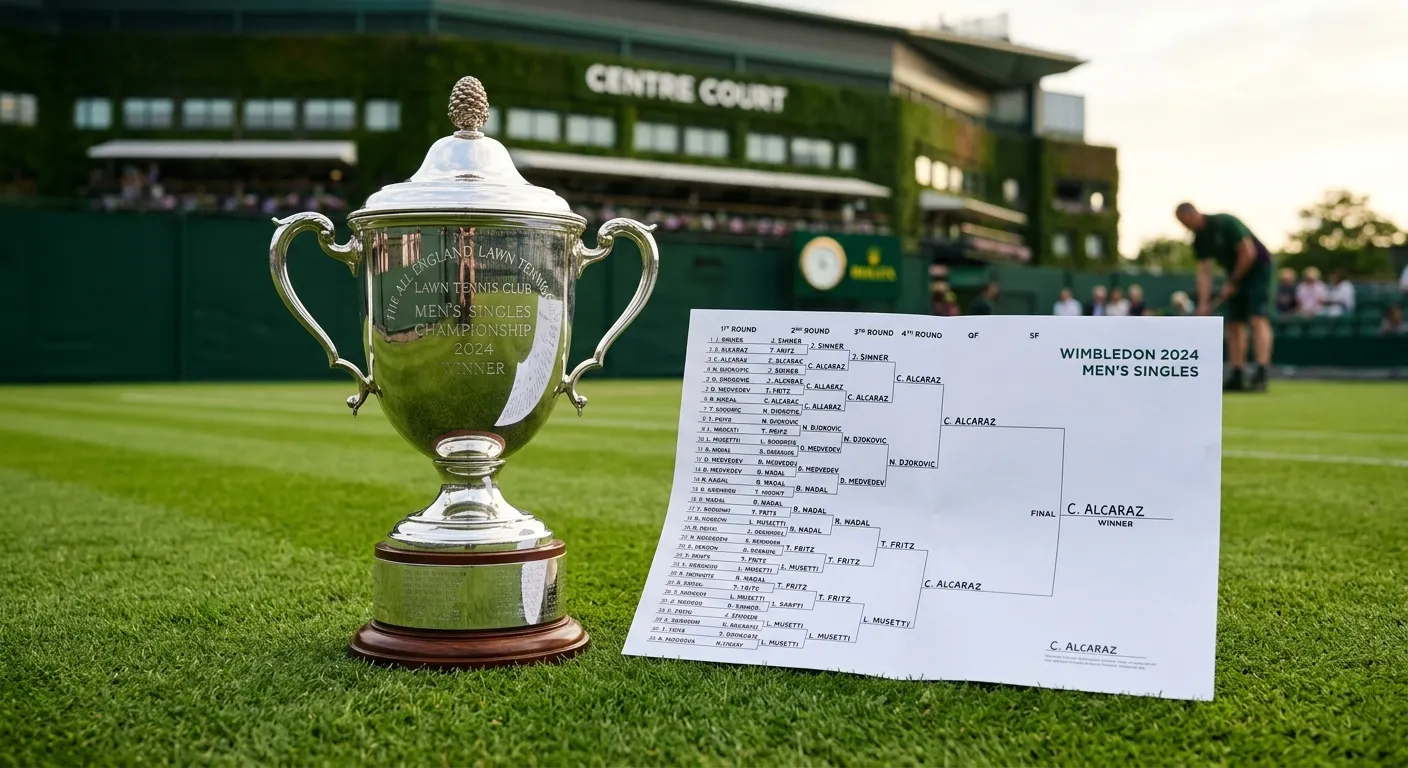
An outright bet, also called a futures or ante-post bet, is a wager on the tournament result rather than a single match. You back a player to win the title, and the bet stays live, win or lose, until they’re either champion or eliminated. The appeal is obvious: the prices are long, the payouts are juicy, and the 2025 singles champions each took home a record £3 million, so it’s a market with genuine glamour attached. The catch is equally obvious once you say it out loud: your stake is tied up for up to two weeks, and a single bad afternoon in round one ends it.
That’s the trade. Long odds in exchange for low strike rate and locked capital. A draw of 128 players means even a strong favourite has to win seven matches without a single off day, against an upset, an injury, or a hot opponent. Outright betting rewards patience and a small stake, not the rent money.
This is where the to-reach-the-final and to-reach-the-semi-final markets earn their place. They sit in the middle ground. Instead of demanding your player win everything, they ask only that your player navigate their half of the draw. The price is shorter than the outright, but the bar is lower, and crucially the bet resolves before the trophy is lifted. For a beginner who wants tournament-long engagement without an all-or-nothing title bet, “to reach the final” is frequently the smarter structure.
The skill in both markets is reading the draw, not just the names. A player landing in a soft quarter, with no seed they fear until the latter stages, is worth more than their ranking suggests. A favourite stuck behind three dangerous floaters is worth less. The price reflects the book’s read of the draw; your edge is reading it differently and better. When you back an outright or a stage market, you’re not betting on a player, you’re betting on a path.
Set betting and correct score
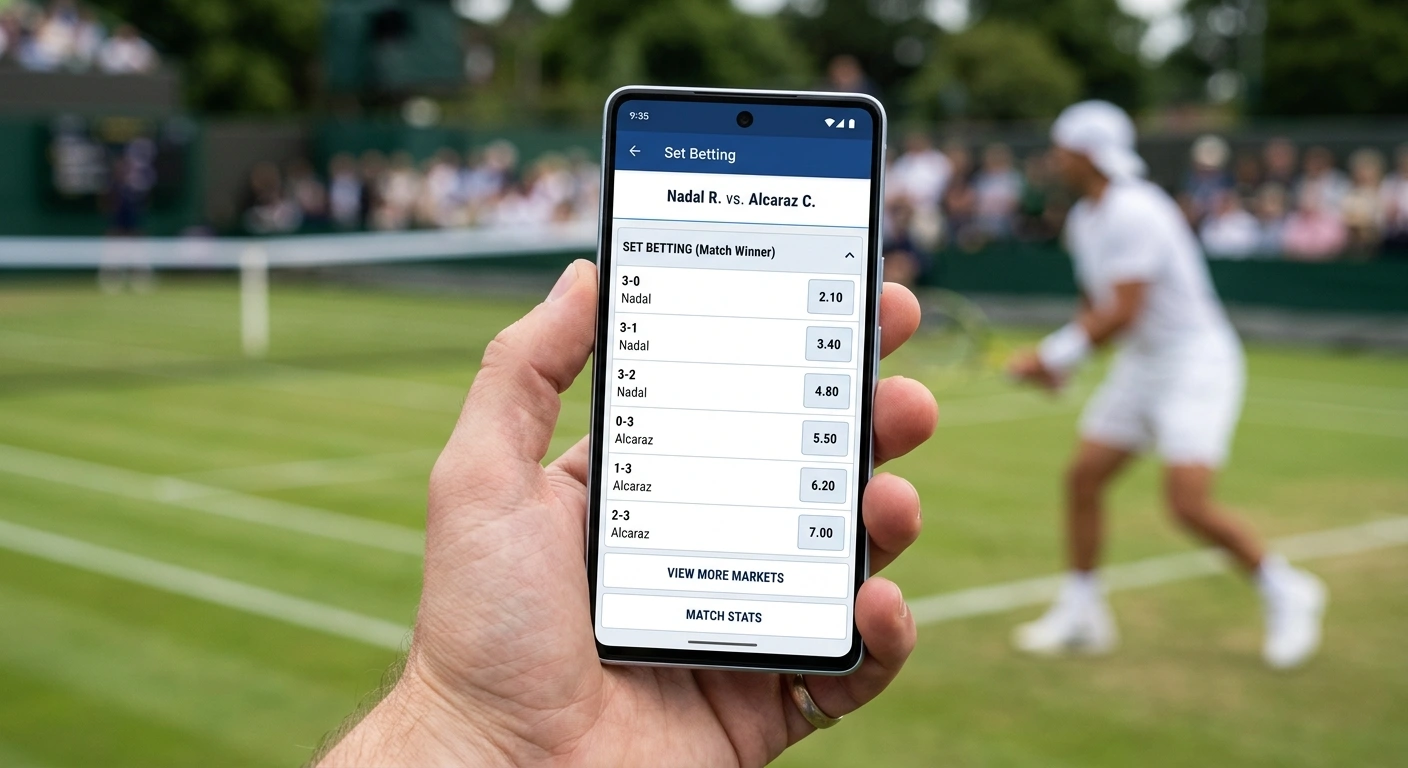
I once watched a friend turn a winning instinct into a losing bet, and the lesson stuck. He was right that the favourite would win in straights. He backed the player to win the match. He won a pittance. Had he backed the correct set score, the exact way the match would finish, he’d have trebled it. Same read, same result, vastly different return, all because he didn’t know set betting existed.
Set betting is a wager on how the sets fall, not just who wins. In men’s tennis, played best-of-five, you can back a 3-0, 3-1, or 3-2 finish for either player. In women’s tennis, played best-of-three, the options are 2-0 or 2-1. Because you’re predicting more detail, the price is longer than a plain match-winner bet, and that extra length is the reward for the extra precision you’re claiming.
Correct score, in the tennis sense, usually refers to this exact set-score market, and it’s worth being clear about the difference between the two terms because books label them inconsistently. Set betting and correct set score are, in practice, the same family: you’re naming the precise set tally. The trap is treating it like a free upgrade on a match-winner bet. It isn’t. Predicting 3-0 instead of just “to win” is a genuinely harder call, and on grass, where a single broken serve can flip a set, scorelines are less predictable than they look on paper.
Where set betting shines is the heavy favourite. When a top seed faces a qualifier on grass, the match-winner price might be so short it’s barely worth backing. The 3-0 or 2-0 set-score bet, though, offers a far more attractive number while still backing the same likely outcome. You’re paid for specifying the manner of victory you already expected. That’s the structural edge: extracting value from a result the market already agrees on.
A word of caution that the integrity world drills into anyone who watches these markets closely. Unusual movement on a set-betting line isn’t always meaningful. As the International Tennis Integrity Agency puts it, “Unusual betting patterns can arise for many reasons besides match-fixing, such as mistaken odds-setting, informed betting, and a player’s form and fatigue.” A price that looks wrong is far more often a player nursing a niggle or a book correcting an error than anything sinister. Read the movement, but don’t read conspiracy into it.
For settlement, the detail that catches beginners every year: if a player retires mid-match, set-betting bets are usually voided and stakes returned, but the exact rule varies by book and by how far the match had progressed. Always check the operator’s tennis rules before you back a precise scoreline, because a retirement turns a “winning” set-score bet into a refund, not a payout.
Game handicaps and total games
Two markets, one idea: stop betting on who wins and start betting on by how much. Handicaps and totals are where Wimbledon betting gets interesting, because they let you have a strong opinion on a match even when the winner is barely in doubt.
Start with the game handicap, sometimes called the spread. Instead of backing a player to win the match, you back them to win by a certain margin of games, or to lose by fewer than a certain margin. A handicap of -4.5 games on a favourite means they need to win four and a half more games across the match than their opponent for your bet to land. Back the underdog at +4.5 and you win as long as they lose by four games or fewer, even if they lose the match outright. It’s a way of saying “the favourite wins, but it’ll be closer than the price suggests,” or the reverse.
Grass does something specific to handicaps, and it’s the kind of detail that separates a considered bet from a guess. Because serve dominance is so extreme on the surface, sets are frequently tight, decided by a single break or a tie-break, and that tightness compresses the margins. A favourite expected to cruise on clay might win a grass match by a far slimmer game count, because their opponent holds serve far more easily. The handicap line bakes this in, but the market doesn’t always price it perfectly, and that’s the opening.
Total games, the over/under, works on the same principle from a different angle. You’re not backing a player at all. You’re backing the match to be long or short, over or under a line of total games set by the book. Two big servers on grass, both holding comfortably, push matches toward tie-breaks and high game counts, which favours the over. A clear mismatch, where the favourite breaks early and often, favours the under. Reading a totals line is reading the serve battle: the harder both players are to break, the longer the match runs.
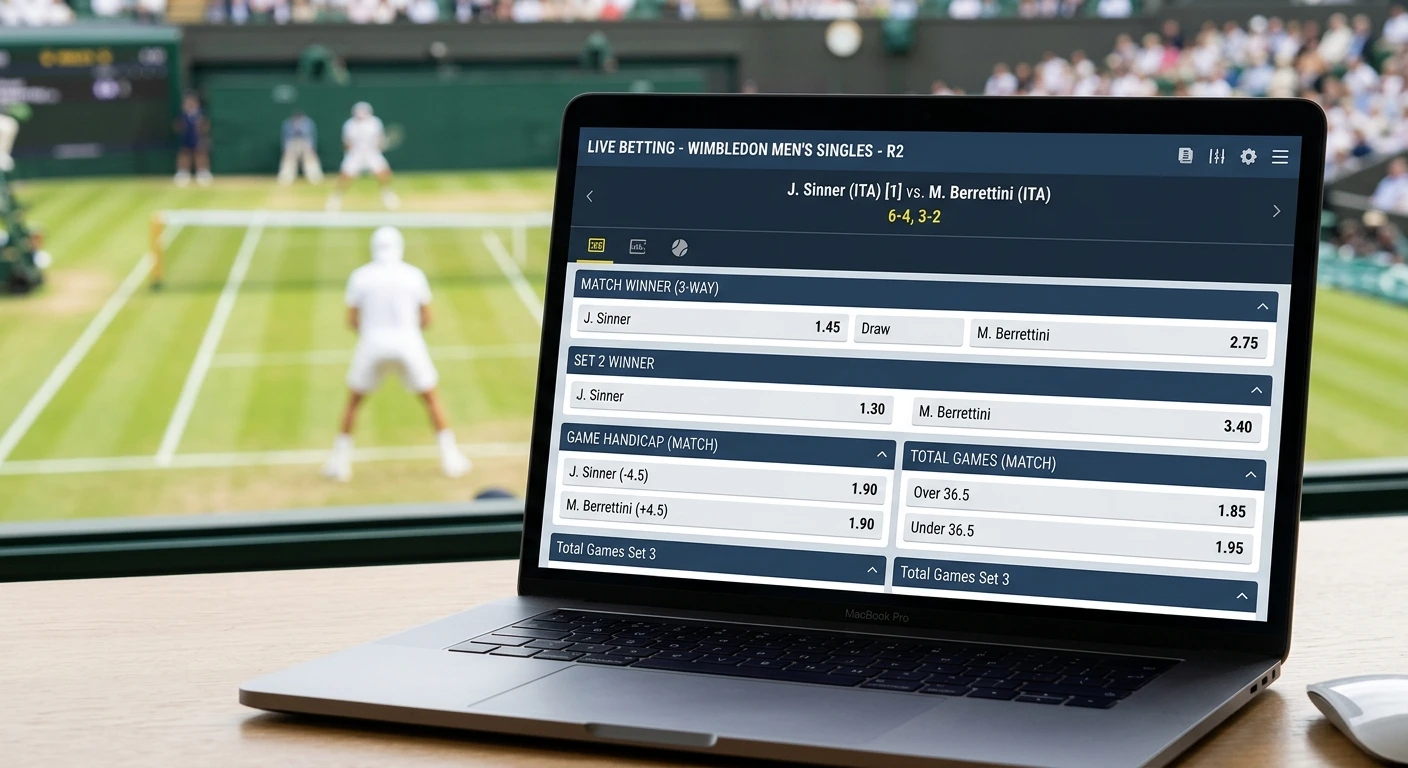
The reason I love these markets for improving bettors is that they force you to have a more precise opinion than “this player is better.” You have to think about how the match plays out, and on grass, where the surface dictates so much of the rhythm, that thinking is where the value lives.
Accumulators and bet builders
Let me save you some money with a single sentence: an accumulator is not a clever way to win more, it’s a fun way to lose more often. I still place them. I just never confuse them with strategy.
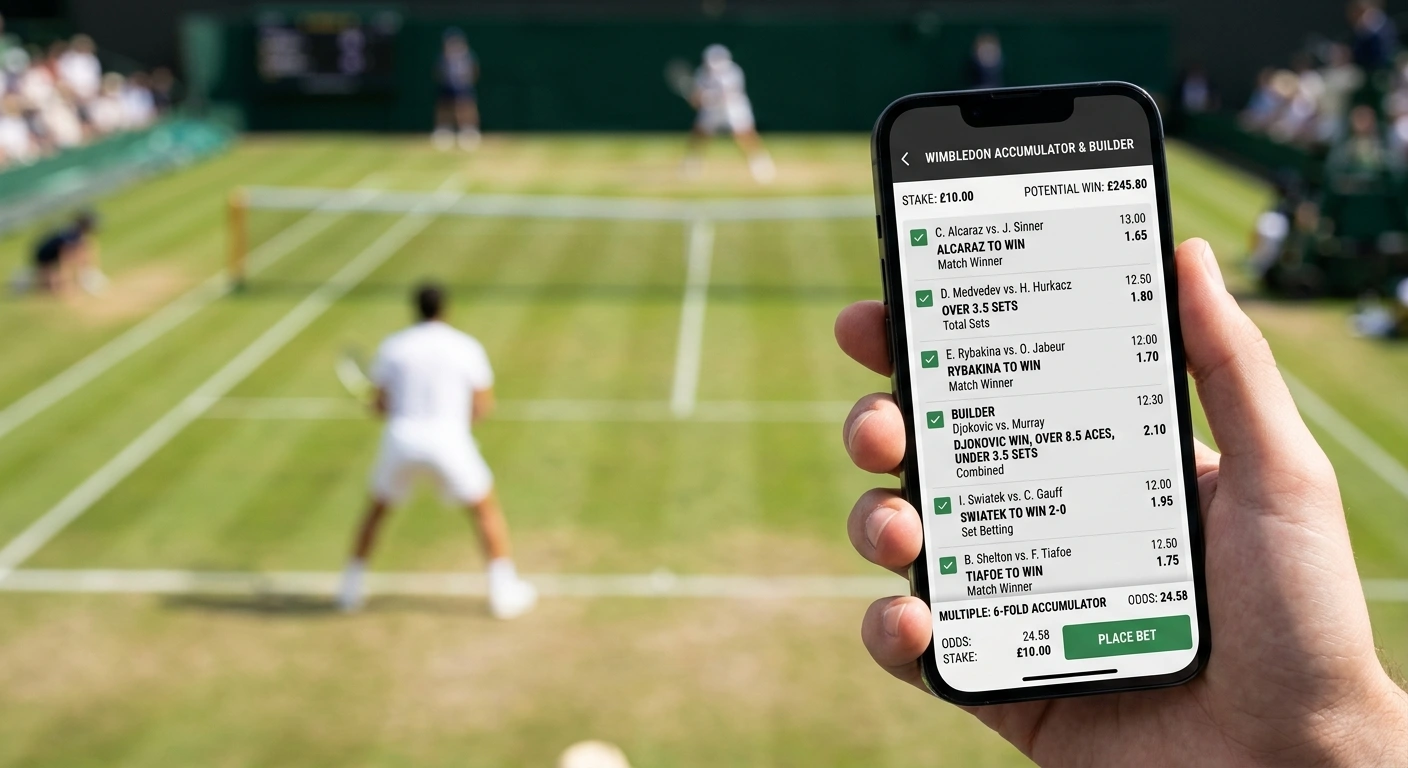
An accumulator, or acca, combines several selections into one bet, where every leg must win for the bet to pay out. The appeal is mathematical seduction: combine four favourites at short prices and the combined odds look generous, because you’re multiplying. The reality is that you’ve also multiplied your chances of losing. Four bets at a 75% chance each don’t give you a 75% chance, they give you barely better than a coin flip that all four land. One upset, anywhere in the chain, and the whole thing is dead.
The bet builder is the modern, more flexible cousin. Instead of combining different matches, it lets you combine multiple outcomes within a single match: the favourite to win, the match to go over a certain number of games, and a particular player to win the first set, all bundled into one price. It feels like skill, and there’s a little more craft to it than a blind acca, but the same warning applies. The more legs you add, the longer the price and the lower the chance.
Where bet builders genuinely add value is correlated outcomes you’ve reasoned through. If you believe a big server will win comfortably and that the match will feature plenty of games, those two views can sit naturally together in a builder. The danger is the opposite: stacking legs because the rising price is exciting, not because the legs belong together. Excitement is the product the book is actually selling you here.
My rule, after nine years, is simple. Accas and builders come out of my entertainment budget, never my staking plan. I size them tiny, I treat the stake as already spent, and any return is a pleasant surprise rather than an expectation. Treat them as a lottery ticket on the tennis and you’ll never be disappointed. Treat them as a route to profit and the maths will, eventually and reliably, find you out.
Can I place every bet type before the matches start, or only some?
Most pre-match markets – match winner, outright, set betting, handicaps and totals – are available before play begins, and outright futures open well in advance. Live-only markets such as next-game winner appear once a match is under way. Bet builders are usually offered both pre-match and in-play.
Can I combine a men’s and a women’s match in one accumulator?
Yes. An accumulator can mix any qualifying selections across both draws, so a men’s match winner and a women’s match winner can sit in the same acca. Just remember every leg must win for the bet to pay, so adding a second match doubles the ways your slip can fail.
How many bet types do I really need to understand before the tournament?
Three is plenty to start: the match winner, set betting and a totals or handicap market. Master how those are priced and you can read almost everything else on the coupon. Outrights, bet builders and the more exotic props can wait until the basics feel automatic, because adding markets you don’t understand only adds ways to lose.
