
 Available in US
Content
Betting the margin, not the winner
There is a moment every July when I look at a top seed priced at 1.10 to beat a qualifier and feel my wallet recoil. Risking ten to win one on a player who could roll an ankle in the warm-up is not betting, it is donating. The game handicap exists for exactly that moment, and learning to use it changed how I attack lopsided matches entirely.
A game handicap, sometimes called the games spread, adjusts the match result by a set number of games before settlement. Instead of asking “who wins,” it asks “by how much.” Back the favourite at a -4.5 games handicap and they need to win by five clear games across the match for your bet to land; back the underdog at +4.5 and they can lose the match outright and still win you money, as long as they keep it close.
That shift — from winner to margin — is what rescues you from those insulting favourite prices. When the moneyline is unbettable, the spread is where the value hides.
How game handicaps are set
The bookmaker sets a handicap line by estimating the likely margin of games, then pricing both sides of that line to roughly even money. The line is the prediction; the near-even prices are how they take their margin. A -4.5 favourite line says, in effect, “we expect this player to win by about five games, and we have priced it so a punt either way is close to a coin flip.”
What feeds that estimate is, above all, serve. On grass, where top players win well over seventy percent of points on their own delivery, breaks of serve are scarce, and scarce breaks mean tighter game margins. A dominant favourite might thrash a weaker player on a slow clay court by a huge games margin, but put the same two on a fast lawn and the underdog’s serve gives him a games floor — he will hold often enough to keep the total margin down even while losing the match. The handicap line has to account for that, which is why grass handicaps tend to be set lower than you might expect from the match prices alone.
The line also moves once betting opens, and watching it move tells you something. If a handicap line drifts from -4.5 to -3.5 on a favourite, the market is signalling that the smart money expects a tighter match than the opening estimate implied — perhaps the underdog’s serve has been holding up well in practice, or the favourite is carrying a niggle. I treat a moving handicap line as information rather than noise, because the bookmakers adjust those numbers in response to the sharpest bets they take, and following the direction of a confident move is often wiser than fighting it.
Why grass tightens the spread
The single most important thing to internalise about handicap betting at Wimbledon is that the surface compresses margins. On grass, the gap between a great player and a merely good one narrows in games terms, because both of them hold serve so reliably that there are simply fewer games to be won or lost on return.
This is the same serve dominance that defines every grass-court market, and it works directly on the spread. When the underdog holds serve at a high rate, the favourite has to break to make ground, and breaks are hard to come by on a fast surface. The numbers make the point: top servers hold around 86 percent of the time on grass, against an average that can fall to roughly 51.7 percent on clay, and that enormous gap is why a games handicap that would be comfortably covered on a slow court so often fails on a lawn. The result is that even comfortable wins are often decided by a single break per set — a 6-4 6-4 rather than a 6-1 6-2 — and a single break per set is a modest games margin. So the favourite who looks utterly dominant on the moneyline frequently fails to cover a large handicap, because the lawn refuses to let the scoreline run away.
A word of realism, though. Game margins are noisy, and a result that looks strange is not always meaningful. The sport’s integrity body is blunt about this: unusual betting patterns “can arise for many reasons beyond match-fixing, such as mispriced odds, informed betting, and player form and fatigue.” A favourite covering by an unexpected distance, or failing to, is usually just form, fatigue or a windy afternoon on an outside court — not a signal of anything. I read game margins as the noisy data they are, and I size my handicap bets accordingly rather than reading meaning into every cover.
When the handicap offers value
The handicap is at its best in two scenarios. The first is the unbettable favourite: when a top seed is priced so short on the match that there is no value left, taking them at a minus handicap lifts the return to something worthwhile — provided you genuinely believe they will win comfortably enough to cover. The second is the live underdog: when you expect a lower-ranked player to be competitive without winning, the plus handicap pays you for being right about closeness, which is a far easier prediction than calling an upset.
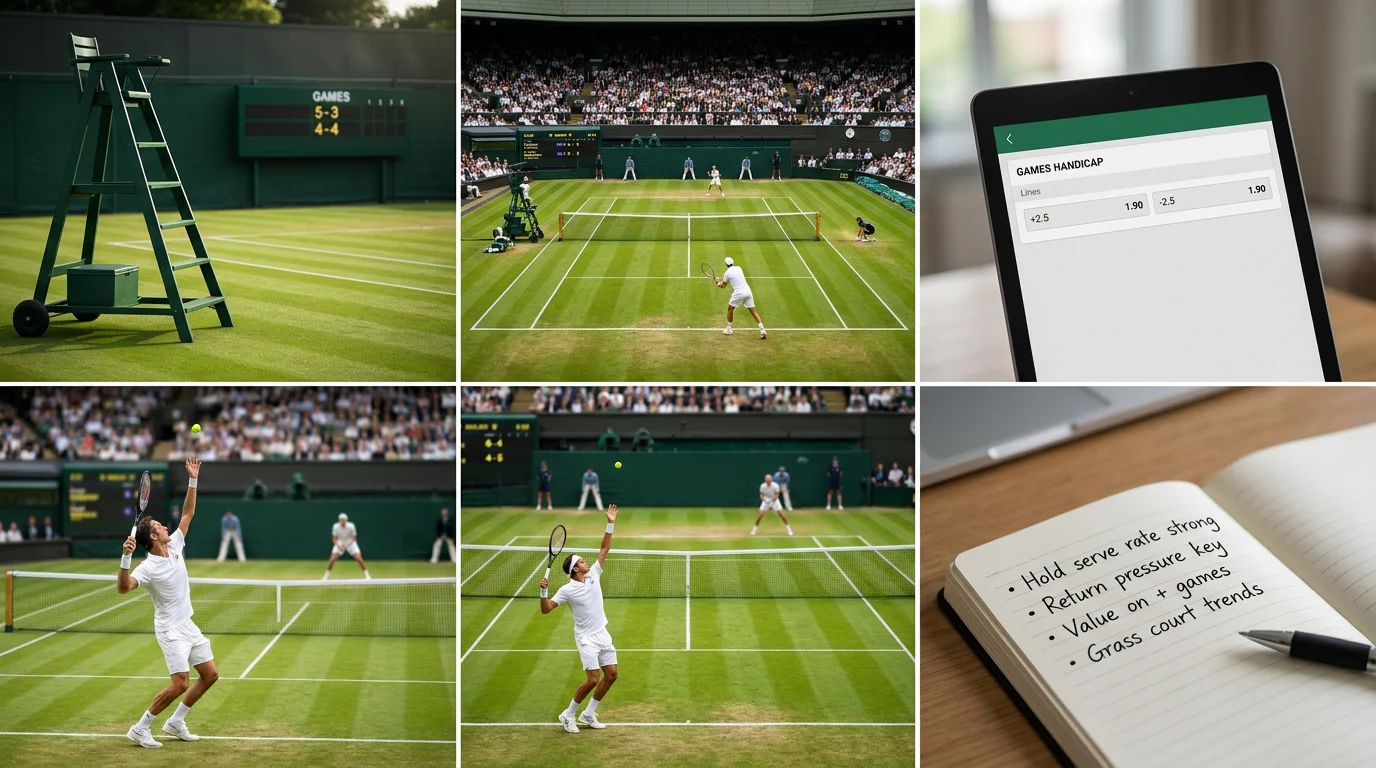
What I avoid is reaching for the handicap on matches I cannot read. The spread rewards a clear view of margin, and margin is hard to forecast when the players are streaky or the conditions are volatile. On grass specifically, I lean towards backing underdogs on the plus line in serve-dominated matchups, because the surface keeps things close and the public keeps overpaying the favourite. When two big servers meet, the total games also climb, which opens a neighbouring market worth a look — I cover it in my guide to Wimbledon total games betting.
What does a -4.5 games handicap mean?
It means the favourite starts the match 4.5 games behind for settlement purposes, so they must win by five or more clear games across the whole match for the bet to land. The half-game removes the possibility of a tie, so there is always a clear winner or loser on the handicap regardless of the actual scoreline.
Is the handicap safer than backing the favourite outright?
Not safer, but often better value. A short-priced favourite on the moneyline offers little reward for real risk, whereas a minus handicap lifts the return if they win comfortably. The trade-off is that they now have to win by a margin, and on grass that margin is harder to achieve because serve keeps scorelines close.
